
 Vietnam
 The Philippines
 India

A US company that hires its own developers takes a median of 44 days to fill a role, according to SHRM’s 2025 recruiting benchmarks. Organizations with 5,000 or more staff take 61. Hiring a whole offshore development team the same way, one role at a time, can take most of a quarter before anyone writes code.
The faster route decides scope, team size and the hiring model before the first interview, then runs the first 90 days to a plan. The steps below assume a US company hiring full-time offshore developers in Vietnam, the Philippines or India.
- Decide what the team will own before you decide how many people to hire.
- Keep each team at 10 people or fewer, the size the Scrum Guide and Amazon's two-pizza rule both point to.
- Choose the hiring model before the country: your own entity, a hiring partner that employs for you, freelancers, or a project vendor.
- A team of five full-time offshore developers through Hire Offshore costs $149,940 to $359,940 a year, all-in.
- Put IP assignment, confidentiality and data protection in writing before anyone gets repository access.
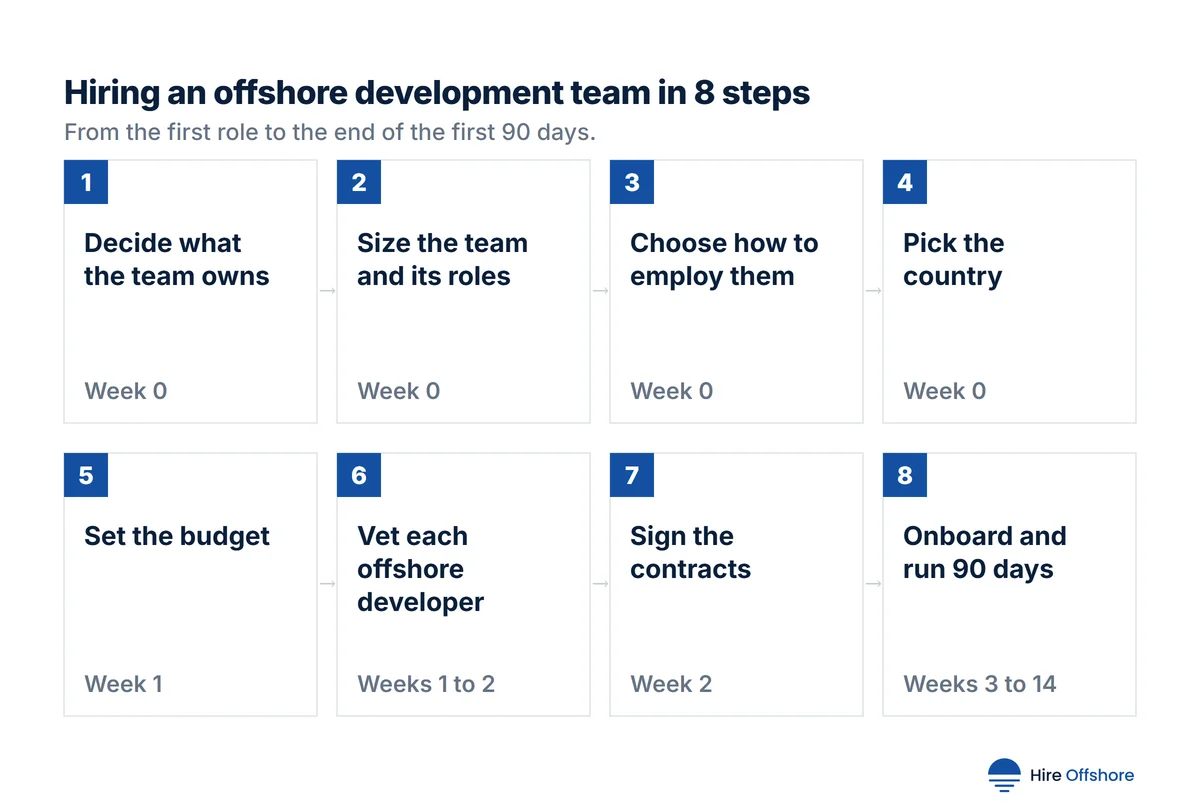
Step 1: Decide what the team will own
An offshore development team works best with a clear piece of the product to own. “Help with the backlog” produces a queue of tickets and a lot of waiting. “Own the mobile app” or “own the billing service” produces a team that makes decisions inside its own area.
Write down three things before you write a job description:
- The scope. Which product area, service or set of repositories the team owns, and what it does not touch.
- The interfaces. Who the team works with in the US, and which decisions still need a US sign-off.
- The first 90-day outcome. One thing the team should have shipped by the end of the first quarter.
If the work is a fixed project with an end date, such as a single app build or a migration, a team you employ may be the wrong tool. A project vendor that quotes the whole job can fit better, as the model comparison in step 3 shows.
Step 2: Size the team and choose its roles
The Scrum Guide describes a team as “typically 10 or fewer people”. Amazon’s two-pizza rule, set out on the AWS Executive Insights page, says no team should be bigger than two pizzas can feed, and puts the ideal below ten. Past that size, communication starts to cost more than the extra hands save.
For a first offshore development team, three to five people is a common starting point:
| Team size | Typical shape | When it fits |
|---|---|---|
| 3 | A senior offshore developer as lead, two mid-level offshore developers | One service or one app, with a US product owner |
| 5 | A lead, three offshore developers, one QA engineer | A product area with its own release cycle |
| 8 | A lead, five offshore developers, one QA engineer, one DevOps engineer | Several services, or web and mobile together |
Hire the lead first. A senior offshore developer who joins a week or two ahead of the rest can set up the repositories, the branching rules and the review process. The lead can also sit in on the later interviews.
Keep product ownership in the US at the start. A US product owner who writes the tickets and accepts the work keeps the offshore team close to the customer, and the overlap hours in step 4 make that practical.
Step 3: Choose how the team will be employed
This is the decision that shapes cost, speed and risk the most, and it comes before the country. There are four common models.
| Model | Who employs the offshore developers | Who manages the work | Time to start |
|---|---|---|---|
| Your own entity | You, through a company you register in the country | You | Months, to set up the entity first |
| Hiring partner or employer of record | The partner, in the country | You | Weeks |
| Freelancers | Nobody: each one is self-employed | You | Days to weeks, one person at a time |
| Project vendor | The vendor | The vendor, against a scope you agree | Weeks, for a defined project |
Your own entity gives you full control, and it suits a company that plans to run a large team in one country for years. It also means registering a company, opening local payroll and following local labor law yourself. Our guide to building an offshore team in Asia covers what an entity takes in Vietnam, the Philippines and India.
A hiring partner employs the offshore developers in their country, runs payroll and contributions, and leaves the day-to-day work to you. This is how Hire Offshore works. You get a team that reports to you without setting up a company first.
Freelancers are quick to hire one at a time but hard to hold together as a team, and they carry their own risks on IP and worker classification. Our freelance vs full-time comparison prices both routes.
A project vendor delivers an agreed scope and manages its own people. It suits a fixed project better than a product you will keep building.
Build your own entity
- Full control of hiring, pay and policy
- Months of setup before the first hire, and local compliance is yours to run
Use a hiring partner
- Offshore developers who work only on your product, employed locally for you
- Shortlist in 24 hours, hire in 2 weeks, no entity needed
Step 4: Pick the country
With the model decided, the country comes down to time zones, English, the stacks you need and local employment rules. Vietnam is UTC+7, the Philippines UTC+8 and India UTC+5:30, so a standard local day shares no hours with a US office.
Offshore developers on a shifted schedule give 4 to 6 hours of overlap with a US workday, and we agree that schedule before the offer. Our Vietnam vs Philippines vs India comparison sets out talent pools, English scores, pay and holidays side by side. The Vietnam, Philippines and India pages list the employment rules in each.
Many teams put the whole team in one country at the start. One time zone and one holiday calendar make the first few months simpler, and a second country can come later.
Step 5: Set the budget
Through Hire Offshore, each full-time offshore developer costs $2,499 to $5,999 a month, depending on stack and seniority. The fee covers salary, payroll, local employment costs, equipment and our fee, so the team budget is the headcount times the fee.
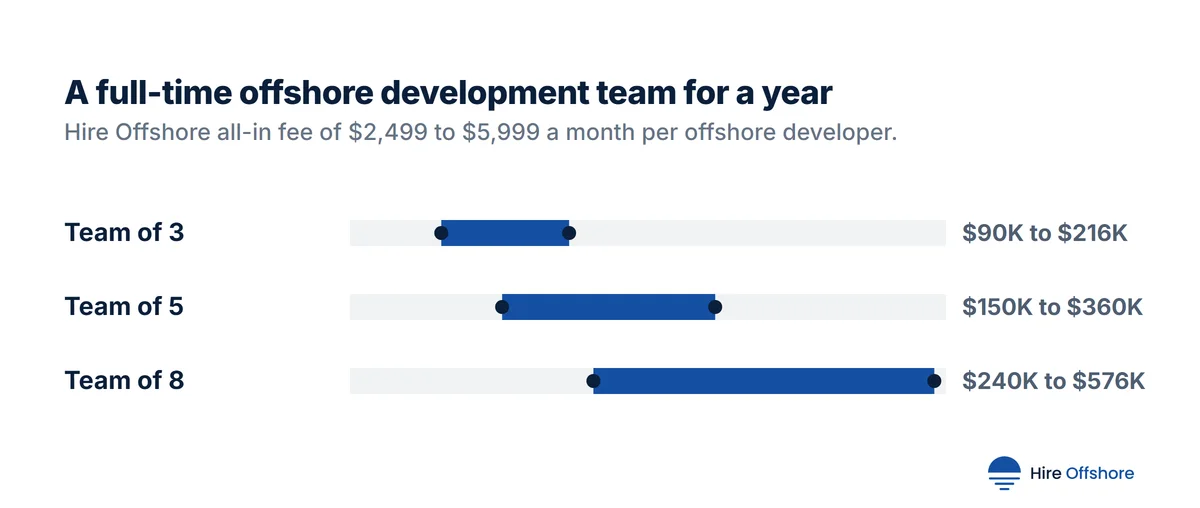
| Team | Monthly | First year |
|---|---|---|
| 3 offshore developers | $7,497 to $17,997 | $89,964 to $215,964 |
| 5 offshore developers | $12,495 to $29,995 | $149,940 to $359,940 |
| 8 offshore developers | $19,992 to $47,992 | $239,904 to $575,904 |
Budget for the US side as well: the product owner’s time, the tools each seat needs, and any travel if you plan to meet the team in person. Our offshore developer rates in US dollars guide compares the fee with freelance and agency rates. Our offshore vs onshore cost comparison prices the same team as US hires.
Step 6: Vet each offshore developer
A team is only as good as the people on it, so vet each hire on its own merits, not as a batch. The checks that matter most are identity, a structured technical interview, a work sample in your own stack, written English and how the person works on a distributed team.
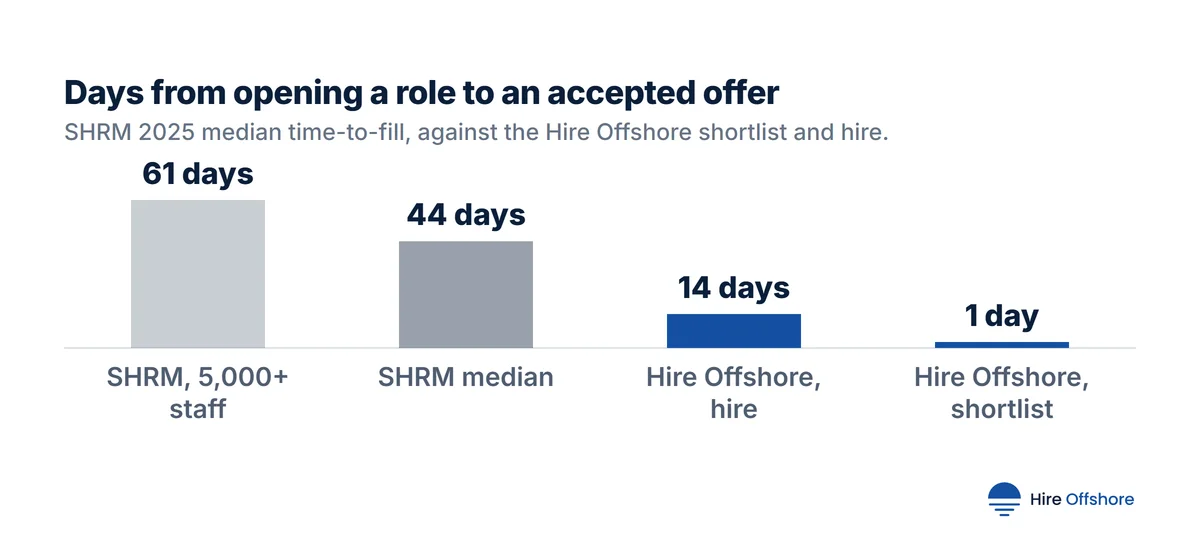
The SHRM 2025 recruiting benchmarks count time-to-fill in calendar days, from the day a requisition opens to the day a candidate accepts. A US company running five searches in parallel can still spend two months on the team.
We shortlist 6 to 8 vetted offshore developers per role within 24 hours and complete each hire in 2 weeks. You interview the shortlist and make the final call. Our guide on how to vet offshore developers sets out each check, with a checklist you can use for any route.
Step 7: Put the contracts in place
Three things need to be in writing before an offshore developer opens your repository.
Who owns the code. Under US law, an employer owns a “work made for hire” that an employee creates within the scope of the job, per the Copyright Office’s Circular 30. Commissioned work counts only if it falls in one of nine listed categories and both sides sign an agreement that says so. Most custom software does not fall in those categories.
An offshore developer is employed under the law of Vietnam, the Philippines or India, not as your US employee. So the contract needs an IP assignment clause that transfers the rights in the work to you. Our placements include an IP assignment to the client and an NDA.
Confidentiality. An NDA covers your code, your data and your plans. It should bind the offshore developer directly, not only the company that employs them.
Data protection. If the team will see customer data, check the rules where they work:
- Vietnam. The Law on Personal Data Protection, Law No. 91/2025/QH15, took effect on 1 January 2026, as Tilleke & Gibbins explains. Fines for cross-border transfer violations can reach 5% of the previous year’s revenue.
- Philippines. The Data Privacy Act of 2012 keeps the company that controls personal data accountable when it moves that data abroad or uses a subcontractor.
- India. The Digital Personal Data Protection Act 2023 is coming into force in phases. Its Rules were notified on 14 November 2025, and most duties start 18 months later, per the Press Information Bureau.
The simplest rule: give the offshore team access to production data only when a ticket needs it, and use masked or test data everywhere else.
Step 8: Onboard the team and run the first 90 days
Onboarding is where many teams lose the first month. In Gallup’s onboarding research, only 12% of US employees strongly agreed their organization onboards new staff well, and only 29% of new hires felt fully prepared afterwards.
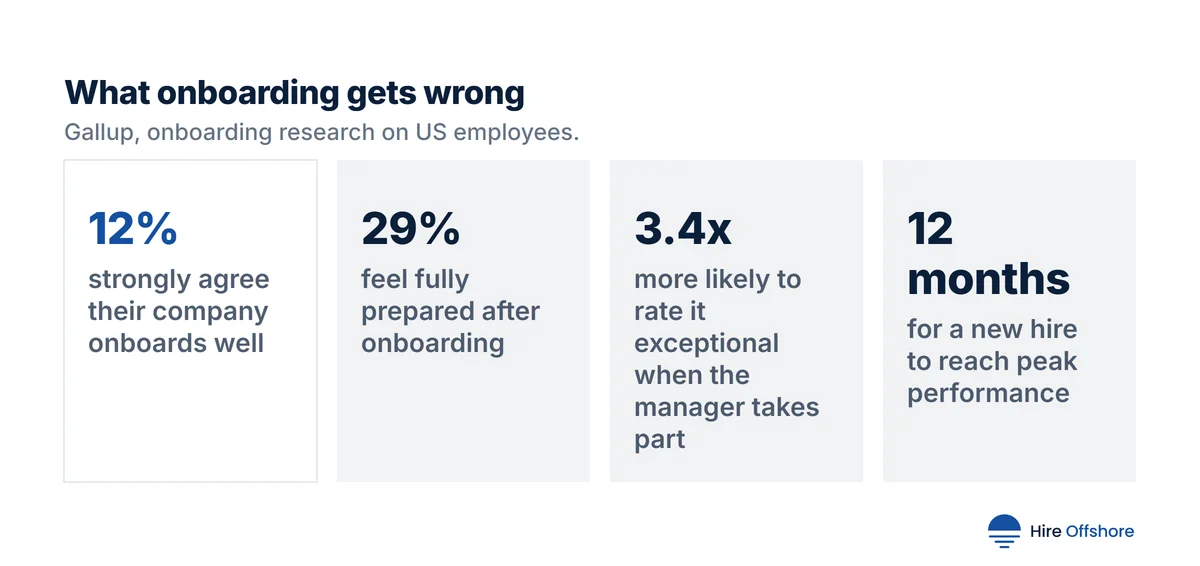
Gallup also found that new hires are 3.4 times as likely to rate their onboarding as exceptional when their manager takes an active part. For an offshore development team, that means the US manager or product owner runs the first week, not only a ticket queue.
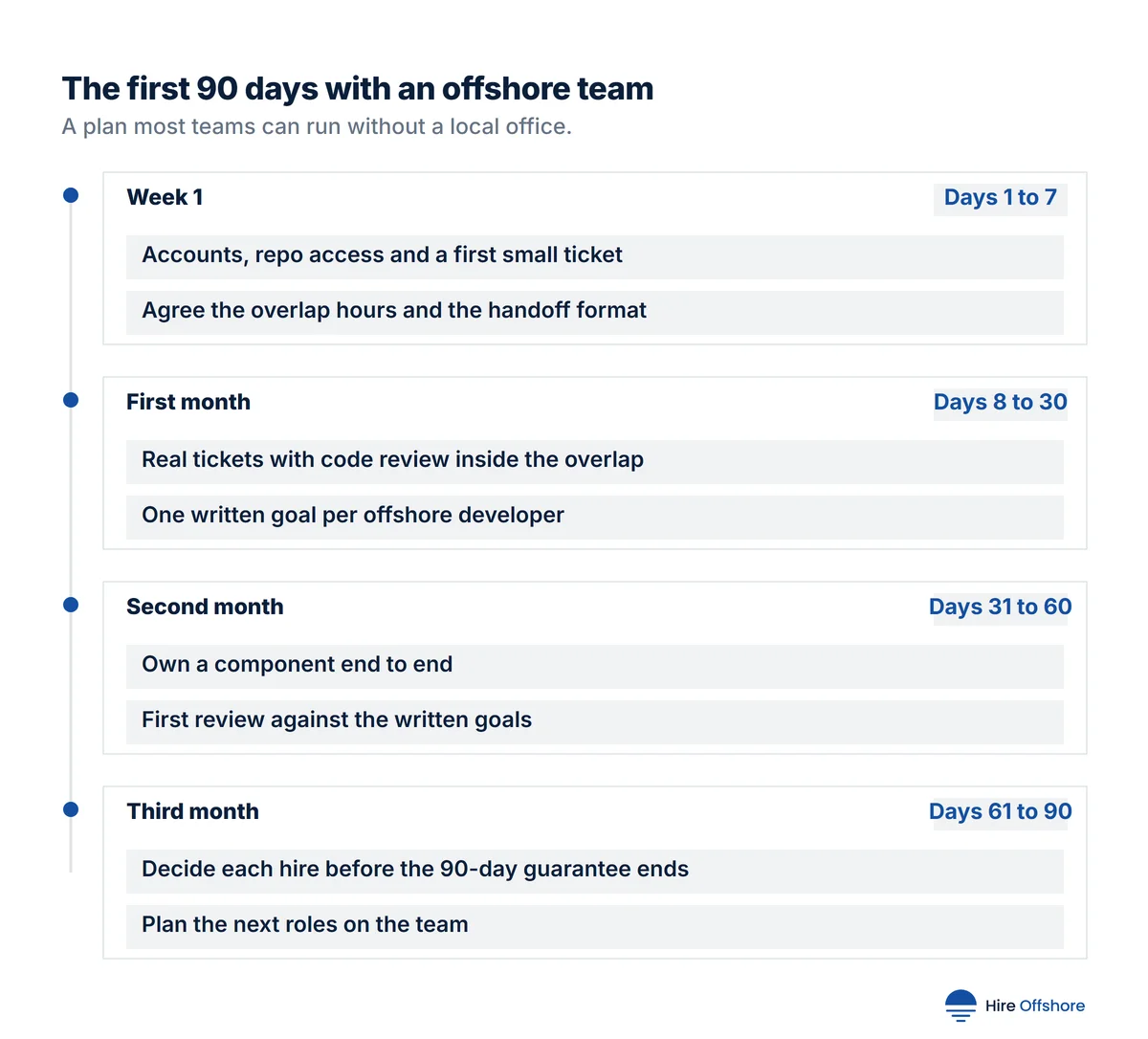
Distributed teams run best on writing. GitLab’s Remote Manifesto lists “Communicate Asynchronously” among its principles, and the habit matters more across a time difference. Keep one live meeting inside the overlap, a daily standup or a review, and move status updates, design notes and handoffs into writing.
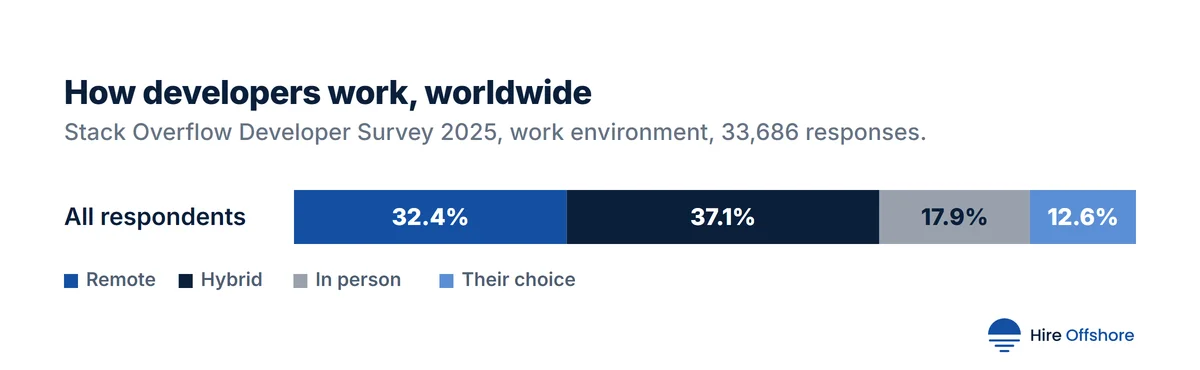
Remote work is already normal for developers. In the Stack Overflow Developer Survey 2025, 32.4% of respondents worked fully remote and 37.1% hybrid, against 17.9% fully in person. Most offshore developers you hire will have worked this way before; what they need from you is a clear way to hand work over.
Our guide to managing offshore developers covers overlap schedules, written handoffs and code review across time zones in more detail.
Use the 90 days on purpose. By the end of the third month you should know whether each hire fits. If one does not, we replace that offshore developer at no extra cost within the 90-day window.
Mistakes to avoid
- Hiring the whole team in one week. Add the lead first, then the rest in a second wave, so the team has someone to set the standards.
- Splitting one team across too many time zones. Two zones far apart leave almost no shared hours for the team itself.
- Leaving IP and access to the end. Sign the contracts before access, not after the first commit.
- Treating the offshore team as overflow. A team with only leftover tickets has nothing to own and little reason to stay.
- Skipping the product owner. Without someone in the US who writes and accepts the work, the team waits on answers.
Hire offshore developers with Hire Offshore
We shortlist 6 to 8 vetted offshore developers per role in Vietnam, the Philippines or India within 24 hours and complete the hire in 2 weeks. Each offshore developer costs $2,499 to $5,999 a month all-in, covering salary, payroll, equipment and employment, with no upfront cost and a 90-day replacement guarantee. See how it works, check pricing or send us the roles for your team.
FAQ
How long does it take to hire an offshore development team?
Through Hire Offshore, we shortlist offshore developers within 24 hours and complete each hire in 2 weeks, so a team of three to five can usually start within a month. A US company recruiting on its own takes a median of 44 days per role, according to SHRM’s 2025 benchmarks.
How big should an offshore development team be?
Three to five people is a common first team: a senior offshore developer as lead, two to three offshore developers and, from five people, a QA engineer. The Scrum Guide puts a team at 10 or fewer people, and larger groups work better split into two teams.
How much does an offshore development team cost?
A full-time offshore developer through Hire Offshore costs $2,499 to $5,999 a month all-in. A team of five costs $149,940 to $359,940 a year, and a team of three $89,964 to $215,964.
Who owns the code an offshore development team writes?
You should, but only if the contract says so. Offshore developers are employed under their own country’s law, so US “work made for hire” rules do not settle ownership on their own. An IP assignment clause in each contract transfers the rights to your company, and our placements include one.
Should I set up my own company to hire an offshore team?
Only if you plan to run a large team in one country for several years and want to manage local payroll and labor law yourself. A hiring partner employs the offshore developers for you, so you can start in weeks without registering a company.