
 Vietnam
 The Philippines
 India
India
A New York team and a Manila offshore developer sit 12 hours apart in July and 13 in January, so a question sent at 5pm in New York arrives at 5am or 6am in Manila.
Managing offshore developers well comes down to what happens in that gap: who answers, how fast work moves, and whether the offshore developer has what they need without waiting a night.
- Philippine law adds at least 10% to every hour worked between 10pm and 6am. Vietnam adds at least 30%.
- At Google the median code change touches 24 lines, and the median review finishes in under 4 hours.
- Only one in 10 employees strongly agree their employer does a good job of onboarding, in Gallup's research.
- Vietnam's 2027 Tết break for the public sector runs 4 to 10 February.
Set the overlap before the first day
Time difference is the one thing a manager cannot fix later, so it belongs in the offer. The gap depends on the pair of cities, and it moves twice a year because US, UK and Australian clocks change while Vietnam, the Philippines and India keep the same offset all year.
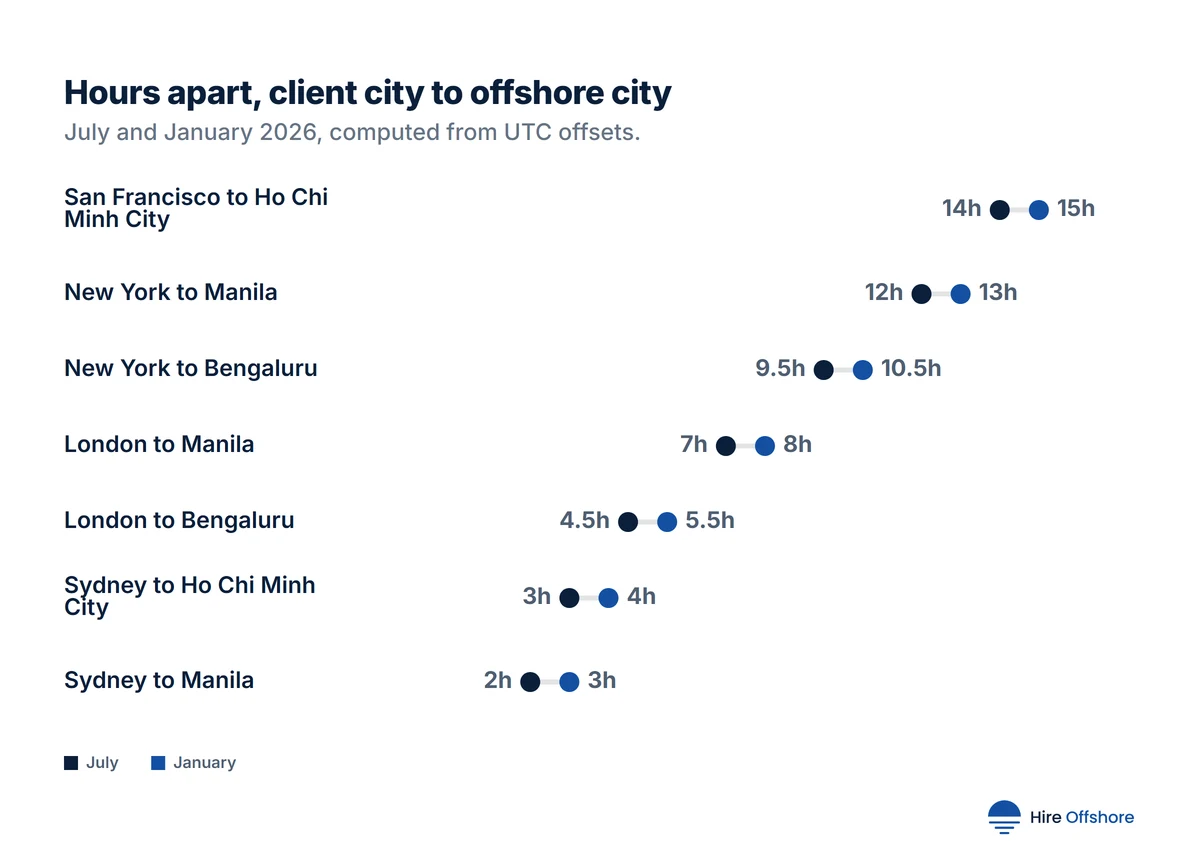
On a standard 9 to 5 on both sides, Sydney shares 6 hours with Manila in July and 5 in January. London shares 3.5 hours with Bengaluru in July and 1 hour with Manila. New York shares nothing with any of the three. The full grid of shared hours is in our nearshore vs offshore cost breakdown.
For a US team the answer is a shifted schedule. A Manila offshore developer working 4pm to 1am covers 9am to 1pm in New York during US daylight time, 4 hours of overlap.
New York falls back on 1 November, and from then the same shift covers only 9am to noon. Moving the start to 5pm keeps the 4 hours. A Vietnamese offshore developer in Ho Chi Minh City gets the same 4 hours on a 3pm to midnight shift.
Late shifts carry a statutory cost:
- Philippines. Article 86 of the Labor Code requires a night shift differential of at least 10% of the regular wage for each hour between 10pm and 6am. The 4pm to 1am shift has 3 such hours a day.
- Vietnam. The 2019 Labour Code defines night as 10pm to 6am (Article 106) and pays night work at least 30% extra (Article 98). The 3pm to midnight shift has 2 such hours.
Agree the shift, the season change and any night premium before the offer, so none of it reopens after the offshore developer starts.
Expect communication to bend around the gap rather than stop. A study of more than 12,000 employees at a Fortune 100 company, published in Organization Science, found that one extra hour of time difference removed 19% of shared business hours but cut real-time communication by only 11%. Employees moved calls and messages outside their standard hours to make up part of the loss.
Run the handoff in writing
With 4 hours of overlap, the other half of each day runs on whatever was written down. In Atlassian’s State of Teams 2025 survey of 12,000 knowledge workers and 200 executives, teams said they lose 25% of their time searching for answers. Across a 12-hour gap, an answer that is not written down costs a full day, because the person who knows it is asleep.
A handoff note at the end of each side’s day closes most of that gap. Keep it to four lines in the ticket or the team channel:
- Done today, with links to the merged pull requests.
- In progress, with the branch name and what is left.
- Blocked on, with the exact question and who can answer it.
- Next, the first thing the offshore developer will pick up tomorrow.
Write decisions where the work lives. A decision made on a call and never posted to the ticket is invisible to the offshore developer who starts 8 hours later. Record demos and design walkthroughs, so a session held in the US afternoon is available at the start of the Manila day.
Keep one live ritual, move the rest to async
The overlap window is short, so spend it on the meetings that need a live conversation and move status reporting into writing.
Inside the overlap
- A short daily standup, at the same time every day
- Pairing and unblocking sessions
- A weekly one-to-one with the manager
- Sprint planning and the demo
Outside the overlap
- Written status updates and handoff notes
- Code review comments
- Recorded walkthroughs and design docs
- Questions that can wait one cycle
Book the standup at the start of the overlap, not the end. A blocker raised at 9am New York time still leaves 3 to 4 shared hours to clear it. Raised at noon, it waits until the next day.
The weekly one-to-one matters more for an offshore developer than for a colleague down the hall, because there are no corridor conversations to fill the gaps. It is where an offshore developer raises problems that do not come up in a standup.
Keep code reviews small and fast
Code review is where time zones hurt most, because each round of comments can cost a day. Google’s engineers show what a fast review looks like. In “Modern Code Review: A Case Study at Google”, drawn from 9 million reviewed changes, the median review finished in under 4 hours across all change sizes. Small changes got first feedback in under an hour; the largest waited about 5 hours.
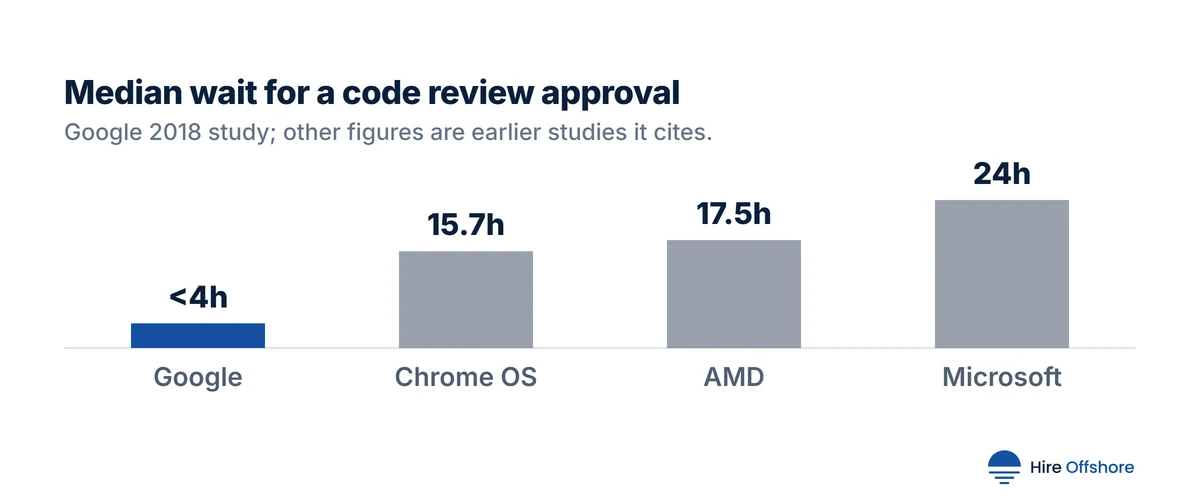
Google’s speed comes from the size of the changes. The paper puts the median change at 24 lines, says over 35% of changes touch a single file, and says fewer than 25% of changes have more than one reviewer. For a team split across time zones, the same rules apply:
- Small pull requests. A small change can be reviewed and approved inside one overlap window. A large one usually spans several.
- One required reviewer. Every extra required approval can add another overnight wait.
- A review deadline. Pull requests opened before the overlap are reviewed during it, so the offshore developer wakes up to comments rather than silence.
- Written review standards. A shared checklist for naming, tests and style keeps comments about substance, and cuts the rounds of back and forth.
Plan the first 30 days
Most employers onboard badly, by their own staff’s account. Gallup’s onboarding research found that only one in 10 employees, managers and leaders included, strongly agree their organization does a good job of onboarding. The same research shows which parts of onboarding move the result.
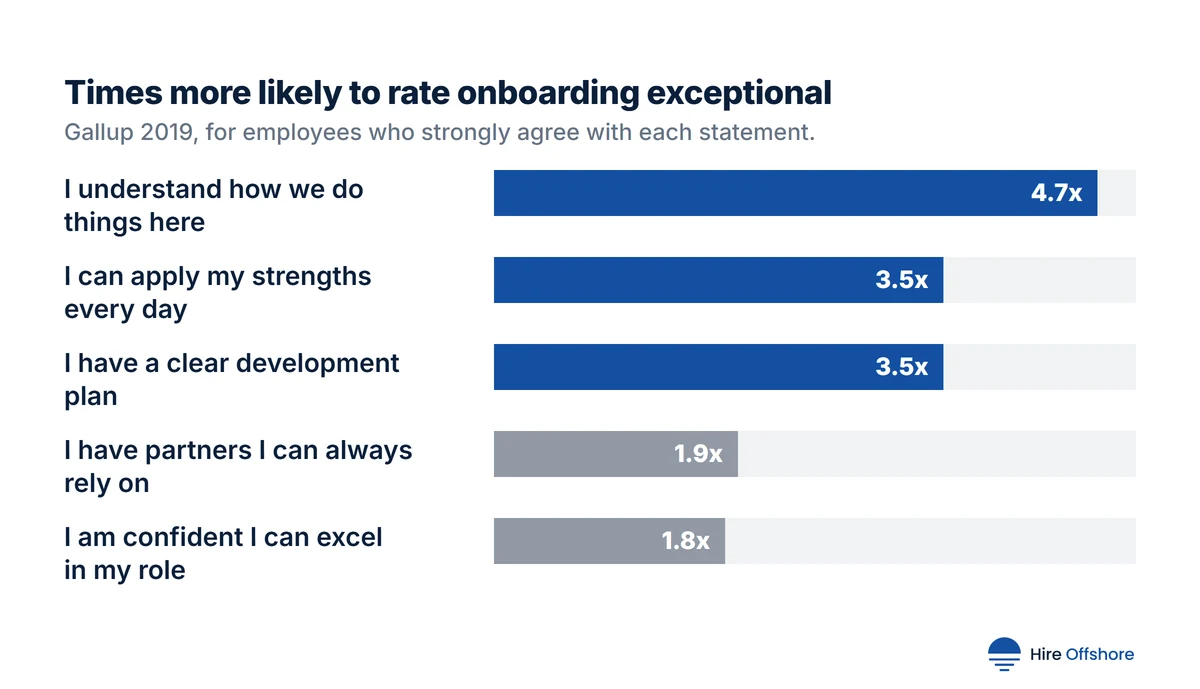
The biggest factor, at 4.7 times, is understanding “how we do things at this organization”. For an offshore developer that is the written version of everything a local hire picks up by sitting nearby. A 30-day plan built on it:
- Week 1. Working laptop, accounts and repository access on day one. A setup guide that gets the project running locally. A named buddy in the overlap window. One small, real change merged by Friday.
- Week 2. A ticket from the normal backlog, sized for one or two days. The team’s review checklist, coding standards and release process, in writing.
- Weeks 3 and 4. A full sprint as a normal team member, including on-call or release duties if the role has them. A 30-day conversation on what is clear, what is not, and what the next 3 months look like.
The development plan in Gallup’s list, at 3.5 times, is the part most teams skip. It does not need to be formal: the skills the offshore developer will build and the work that will build them.
The vetting itself happens before day one. Our guide on how to vet offshore developers covers the technical, English and behavioral checks.
Keep them: what offshore developers stay for
Pay brings an offshore developer in, but the Stack Overflow 2025 Developer Survey ranks something else first. Among the factors that drive job satisfaction, “autonomy and trust to manage your own tasks” came first, ahead of competitive pay and benefits in second and solving real-world problems in third. “You like your manager” ranked ninth.
Source: Stack Overflow 2025 Developer Survey, 26,622 responses to the job satisfaction question.
The largest group, at 47.1%, call themselves complacent rather than happy. For an offshore developer, autonomy and trust mean the same things they mean for anyone: owning a part of the product rather than a stream of tickets, being in the planning conversation, and a manager who measures what ships rather than hours online.
Notice periods give a manager some warning when someone does decide to go. Resigning from a permanent contract takes 45 days’ notice in Vietnam and one month in the Philippines, as our Vietnam and Philippines pages set out.
Plan around each country’s holidays
A release planned for the week of Tết will slip. Holidays cluster at different times in each country, and none of them line up with US or UK calendars.
| Country | Dates to plan around | Source |
|---|---|---|
| Vietnam | 24 November 2026, Vietnam Culture Day. 4 to 10 February 2027, Tết break for the public sector | Viet Nam News |
| Philippines | 25 and 26 March 2027, Maundy Thursday and Good Friday. 30 August, 30 November, 24 and 30 to 31 December 2027 | Proclamation 1427 |
| India | 8 November 2026, Diwali, on a Sunday in the central government list. Other dates vary by state | DoPT memorandum |
Vietnam. The Labour Code gives private-sector employees 5 paid days for the Lunar New Year, and the government sets the public-sector break each year. For 2027 it approved 7 days off, 4 to 10 February, in a Government Office notice issued on 2 October 2026.
Philippines. Proclamation 1427, signed on 8 September 2026, lists 10 regular holidays for 2027.
Seven of them fall on weekdays; Labor Day, Independence Day and Christmas Day fall on Saturdays. Holy Week takes out the Thursday and Friday before Easter, and December has Christmas Eve, Rizal Day on 30 December and the last day of the year. The government announces the two Eid holidays separately each year.
India. The central government memorandum for 2026 lists 14 compulsory holidays for its offices outside Delhi, Diwali among them. State governments publish their own lists, which can put the Diwali holiday on a different day.
Ask each offshore developer for their office calendar in the first week. Our India page covers leave rules in Karnataka.
Hire offshore developers with Hire Offshore
You manage the offshore developer day to day, in your tools and your rituals. We handle employment, payroll, equipment and HR in Vietnam, the Philippines or India, and we agree the working schedule with the offshore developer before the offer.
We shortlist 6 to 8 vetted offshore developers within 24 hours and complete the hire in 2 weeks, for $2,499 to $5,999 a month all-in. See how it works, check pricing or send us the role.
FAQ
Who handles HR for an offshore developer?
We employ the offshore developer in their country, so payroll, statutory benefits, leave and equipment run through our team, while you direct the work.
What happens if an offshore developer resigns?
We start sourcing a replacement straight away. If the hire does not work out in the first 90 days, the replacement costs nothing extra.
How much overlap does an offshore team need?
Enough for one live standup and same-day answers to blocking questions. Many offshore developers work a shifted day that gives a US team 4 to 6 hours of overlap; Australian teams get most of a standard day with Vietnam or the Philippines.