
 Vietnam
 The Philippines
 India

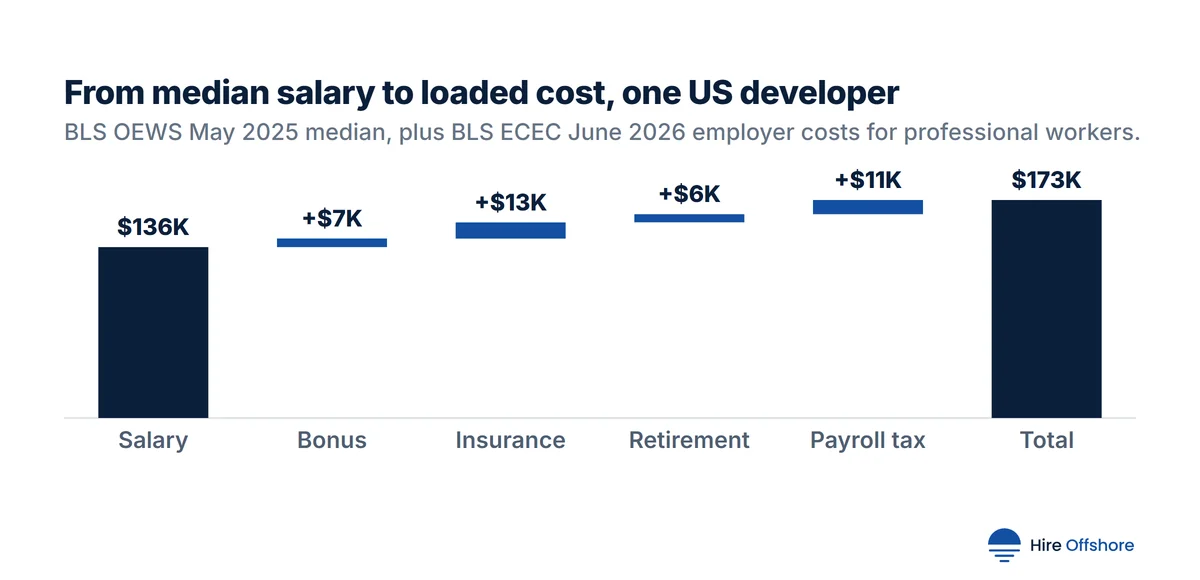
The median US software developer earned $135,980 in May 2025, according to the Bureau of Labor Statistics. Add the bonus, insurance, retirement and payroll taxes a US employer pays on top, and that developer costs about $173,500 a year, before the first job ad goes out.
A full-time offshore developer through Hire Offshore costs $29,988 to $71,988 a year, all-in. Comparing offshore vs onshore developers on salary alone hides most of the US side of that gap, so the sections below price the onshore hire the way an employer pays for it.
- Half of US software developers earn more than $135,980 a year in base pay, and a quarter earn more than $171,980.
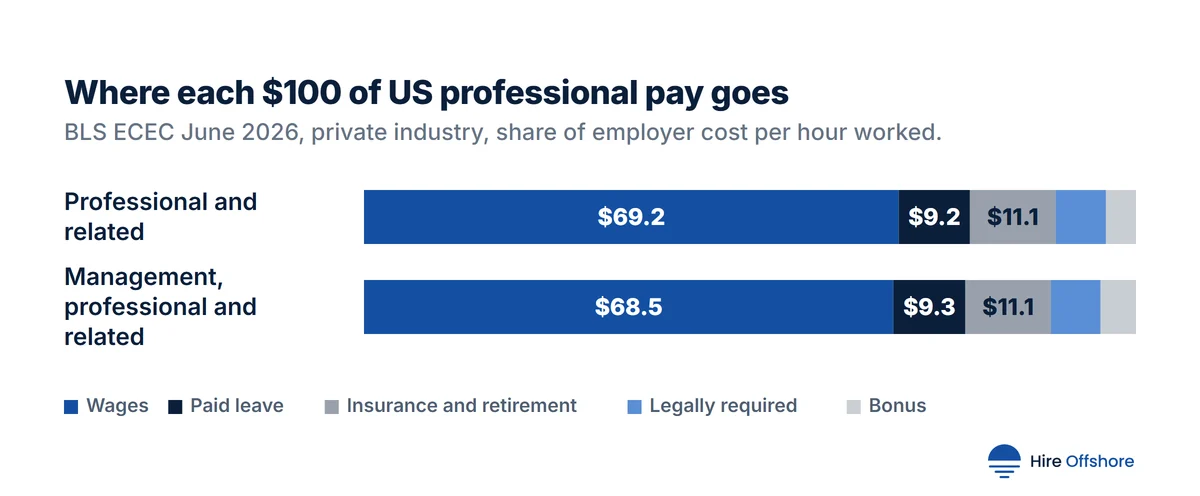
- For US professional staff, bonus, insurance, retirement and legally required benefits add 27.6% on top of an annual salary that already includes paid leave.
- Five US developers at median pay cost about $873,000 in year one. Five full-time offshore developers through Hire Offshore cost $149,940 to $359,940.
- A US employer takes a median of about a month and a half to fill a role, and replacing an employee can cost half to twice their salary.
What an onshore developer earns in the US
The cleanest US benchmark is the Bureau of Labor Statistics’ Occupational Employment and Wage Statistics for software developers, occupation code 15-1252. The May 2025 figures, read on 12 October 2026, cover 1,687,890 employed developers.
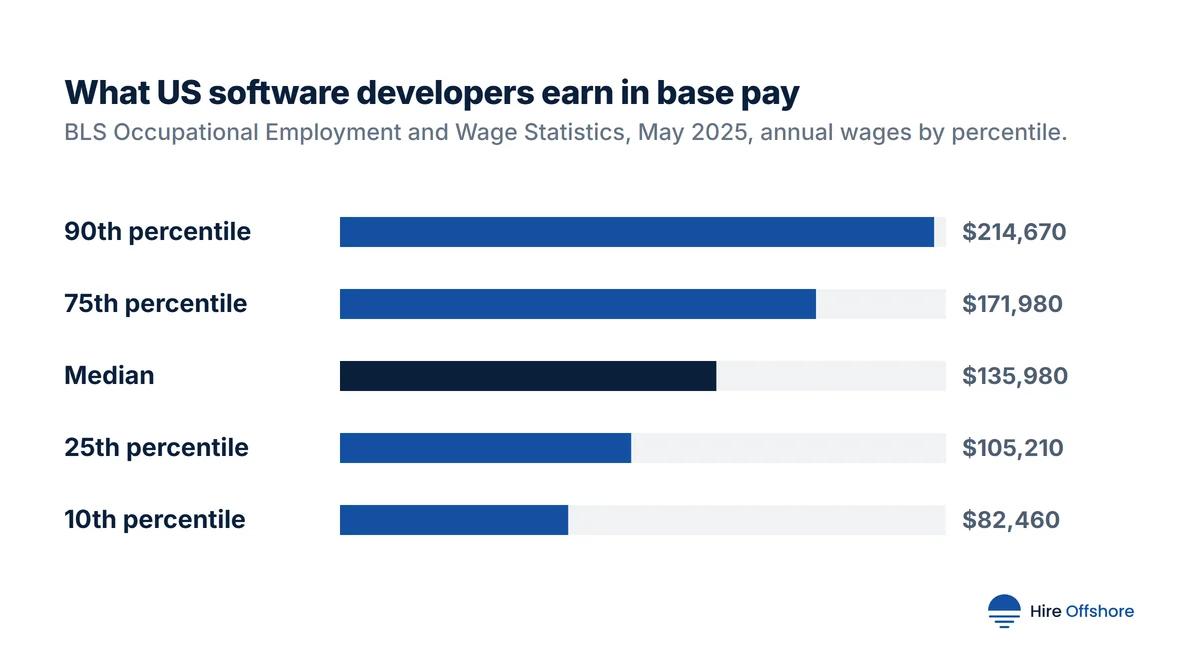
| Percentile | Annual base pay | Hourly, at 2,080 hours |
|---|---|---|
| 10th | $82,460 | $39.64 |
| 25th | $105,210 | $50.58 |
| Median | $135,980 | $65.38 |
| 75th | $171,980 | $82.68 |
| 90th | $214,670 | $103.21 |
These are wages only: no bonus, no benefits, no employer tax. They are also national figures. A developer hired in San Francisco or New York sits higher in the range than one hired in a smaller metro, so a US company should read its own city’s line before budgeting.
The comparisons below use three points: the 25th percentile for a mid-level hire, the median, and the 75th percentile for a senior one.
The employer costs on top of a US salary
A US salary is only part of what the employer pays. The BLS Employer Costs for Employee Compensation release for June 2026, published on 9 September 2026, breaks that down for private-sector professional and related workers, per hour worked:
- Wages and salaries: $50.98
- Paid leave: $6.78
- Supplemental pay, such as bonuses: $2.90
- Insurance: $5.47
- Retirement and savings: $2.75
- Legally required benefits: $4.81
Benefits come to 30.8% of total compensation for this group. Across all private-industry workers the share is 30.0%.
Applied to the median salary, the add-on comes to $37,503 a year, for a loaded cost of $173,483.
Sources: IRS Topics 751 and 759, KFF Employer Health Benefits Survey 2025.
You can check the legally required line against the tax rules themselves.
Social Security and Medicare. The employer pays 6.2% for Social Security and 1.45% for Medicare, per IRS Topic 751. For 2026, Social Security applies to the first $184,500 of wages, and Medicare has no cap. On a $135,980 salary, the employer’s share comes to $10,402.
Federal unemployment. IRS Topic 759 sets FUTA at 6.0% of the first $7,000 of each employee’s wages, cut to 0.6% for employers who pay their state unemployment tax in full and on time. That is $42 a year per employee.
State unemployment. Each state sets its own. In California, the Employment Development Department assigns new employers a 3.4% rate on the first $7,000 of wages, plus a 0.1% training tax on the same base: $245 per employee.
Those three add up to $10,689 for a California hire. The BLS figure of $11,324 is an average across states and also includes workers’ compensation insurance.
Health insurance. The KFF 2025 Employer Health Benefits Survey puts the average family premium at $26,993 a year, with workers paying $6,850 of it. That leaves about $20,143 for the employer. Single coverage averages $9,325, with workers paying $1,440, so the employer pays about $7,885. We read the survey on 12 October 2026.
The BLS insurance line, $12,878 on a median salary, falls between those two figures because it averages across workers who take family cover, single cover, or none.
Equipment and office. The BLS figures leave out laptops, software licences, desks and rent.
A remote US hire needs no desk, but still needs a machine and the licences to work. We have not priced these, because they vary too much by company to average. They push the US figure up, not down.
Recruiting a US developer: cost and time
The SHRM 2025 recruiting benchmarking brief puts the median cost per hire at $1,200 for nonexecutive roles and $10,625 for executive roles.
SHRM’s cost per hire is the sum of agency fees, advertising, job boards, referral bonuses, travel, relocation, recruiter pay and recruiting software, divided by the number of hires.
Read $1,200 with care. It is a median across all nonexecutive roles SHRM’s members fill, not a figure for developers, and a company that pays an outside agency for a developer search pays that agency’s own fee.
Time costs money too. SHRM’s members took a median of about a month and a half to fill a role in 2025, counted in calendar days from the day the requisition opened to the day the candidate accepted. Organizations with 5,000 or more employees took 61 days for nonexecutive roles. A US developer who accepts an offer then often has notice to serve at their current employer, which adds more time before day one.
For a full-time offshore developer, we shortlist 6 to 8 vetted candidates within 24 hours and complete the hire in 2 weeks, with no upfront fee.
When a US hire leaves
Attrition is the cost that does not show up in the first-year budget. Gallup estimated in 2019 that replacing an individual employee costs one-half to two times their annual salary. For a developer on the median salary, that is $67,990 to $271,960 per departure.
The estimate is wide and dated, so we leave it out of the annual totals below. It belongs in the decision anyway: on a five-person US team, one resignation in a year can cost more than an entire offshore developer’s annual fee.
On the offshore side, 92% of the offshore developers we place stay with their team. If a hire does not work out in the first 90 days, we replace the offshore developer at no extra cost. After that window, a resignation still costs the team time to hand over and onboard.
Offshore vs onshore developers: one hire, year one
Putting the pieces together for one developer in the first year:
| Cost line | US hire, median pay | Full-time offshore developer |
|---|---|---|
| Base salary | $135,980 | Included |
| Bonus and supplemental pay | $6,827 | Included |
| Insurance | $12,878 | Included |
| Retirement | $6,474 | Included |
| Payroll tax and other legally required benefits | $11,324 | Included |
| Recruiting | $1,200 (SHRM median) | $0 upfront |
| Laptop and software | Not priced | Included |
| Year-one total | $174,683 | $29,988 to $71,988 |
The offshore figure is the Hire Offshore monthly fee of $2,499 to $5,999 times 12. It covers the salary, payroll, local employment costs, equipment and our fee. Those employment costs differ by country: Vietnam’s 21.5% employer social insurance, the Philippines’ mandatory 13th-month pay, and India’s 12% provident fund contribution all sit inside the fee. The Vietnam, Philippines and India pages list the rules in each.
At the median, the offshore developer costs 59% to 83% less than the US hire. At the 25th percentile, a year-one US cost of $135,427, the gap narrows to 47% to 78%.
Onshore US developer
- $135,427 to $220,611 in year one, 25th to 75th percentile pay
- About a month and a half to fill, and the employer carries attrition risk
Full-time offshore developer
- $29,988 to $71,988 a year, all-in
- Shortlist in 24 hours, hire in 2 weeks, 90-day replacement guarantee
Five developers for a year
The gap scales with headcount. For a team of five, each US figure below is five loaded salaries plus five median recruiting costs.
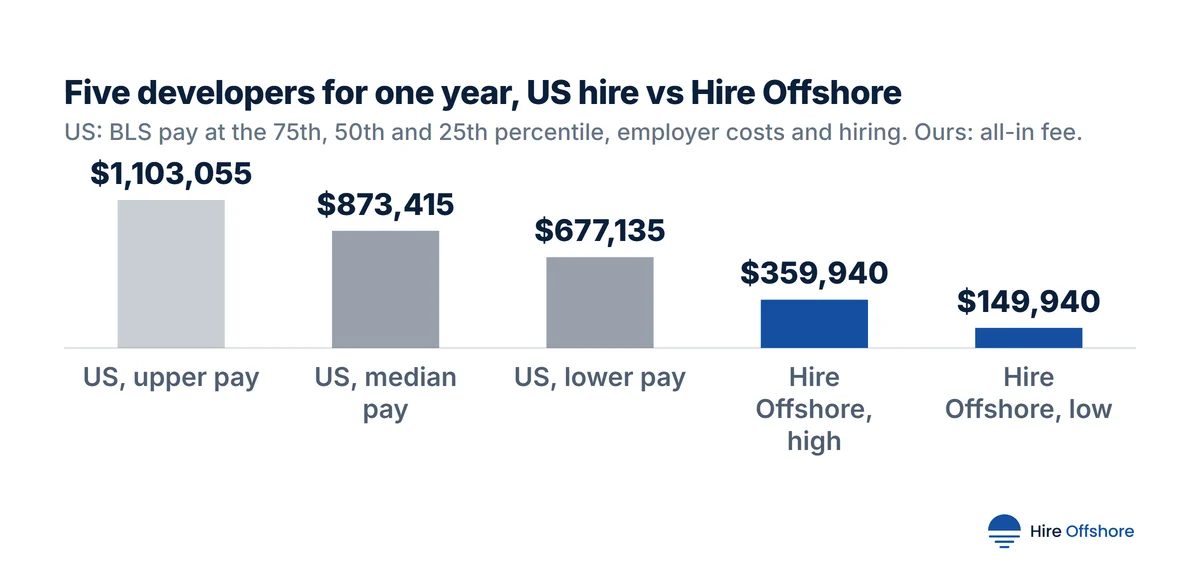
| Team of five, year one | Annual cost |
|---|---|
| US hires at 75th percentile pay | $1,103,055 |
| US hires at median pay | $873,415 |
| US hires at 25th percentile pay | $677,135 |
| Full-time offshore developers, top of range | $359,940 |
| Full-time offshore developers, bottom of range | $149,940 |
Even the most expensive offshore team, five offshore developers at the top of the range, costs $317,195 less than five US hires at the 25th percentile. That difference is more than the year-one cost of one more US developer at 75th percentile pay.
For buyers weighing a third route, our nearshore vs offshore cost comparison sets Latin American and Eastern European rates against the same offshore range.
What the price gap does not cover
A lower price buys a different way of working. These are the trade-offs a US team takes on with offshore developers, and how each one is usually handled.
Time zones. Vietnam is UTC+7, the Philippines UTC+8 and India UTC+5:30, so a standard local day shares no hours with a US East Coast office.
Offshore developers who work a shifted schedule give 4 to 6 hours of overlap with a US workday, and we agree that schedule before the offer. The rest of the day runs on written handoffs. Our guide to managing offshore developers covers how teams run that gap.
Communication. English ability varies by country and, more, by person. The Philippines ranks 28th of 123 countries on EF’s 2025 English Proficiency Index, in the High band, and Vietnam ranks 64th. A national rank does not tell you how one candidate writes a pull request description, so test the person. Our guide on how to vet offshore developers sets out the checks, including written English.
Code ownership. Under US law, work an employee creates within the scope of their job belongs to the employer, per the Copyright Office’s Circular 30. An offshore developer works under local employment law in Vietnam, the Philippines or India, so a contract has to pass ownership to you. Our placements include an NDA and an IP assignment to the client.
Management overhead. An offshore developer needs the same onboarding, code review and one-to-ones as a US hire, done across a time difference. The cost here is manager time, and it is real. It is also the same work a US team does for a US hire, shifted to fit the overlap.
Employment law. Hiring in another country normally means a local entity, local payroll and local labour law. We employ the offshore developer in their country and run payroll, contributions and leave there, so you do not need an entity. Hiring an independent freelance developer instead carries its own risks, which our freelance vs full-time comparison covers.
When onshore is the right call
The cost gap does not settle the decision on its own. A US hire fits better when:
- The work involves export-controlled technology. The Bureau of Industry and Security treats the release of controlled technology or source code to a foreign person inside the United States as a deemed export. Sending the same technology to a developer abroad is an export in the ordinary sense. If your product falls under export controls, check licensing before any offshore hire.
- A contract requires US persons. Some government and defense contracts restrict who may touch the code or the data.
- The role needs a physical presence. Hardware labs, on-site client work and jobs that depend on being in the room with US customers.
- The work runs on live collaboration all day. A founding engineer setting architecture with a US product lead in real time, or a team that pairs for most of its day, will feel the time difference most.
- You are hiring one senior leader to build the function. Some teams hire the engineering lead onshore and build the team around them with offshore developers.
The mix is common. A US lead who owns architecture and a group of full-time offshore developers who build against it keeps the shared-hours work in the US and puts the volume where it costs less.
Hire offshore developers with Hire Offshore
We shortlist 6 to 8 vetted offshore developers from Vietnam, the Philippines or India within 24 hours and complete the hire in 2 weeks. The monthly fee of $2,499 to $5,999 covers salary, payroll, equipment and employment, with no upfront cost and a 90-day replacement guarantee. See how it works, check pricing or send us the role.
FAQ
How much does a US software developer really cost an employer?
About $173,500 a year at median pay, before recruiting. That is the BLS May 2025 median salary of $135,980 plus 27.6% for bonus, insurance, retirement and legally required benefits, using the BLS employer cost figures for professional workers. At the 75th percentile, the figure rises to about $219,400.
How much cheaper is an offshore developer than an onshore one?
A full-time offshore developer through Hire Offshore costs $29,988 to $71,988 a year, all-in. Against a US hire at median pay, including the SHRM median cost per hire, that is 59% to 83% less in the first year.
What employer taxes does a US company pay on a developer’s salary?
7.65% for Social Security and Medicare, with Social Security capped at the first $184,500 of wages in 2026. Federal unemployment tax adds up to $42 a year per employee, and state unemployment tax depends on the state: 3.4% of the first $7,000 for a new employer in California.
When should a company hire onshore developers instead?
Onshore fits better if the work involves export-controlled technology, a contract requires US persons, the role needs someone on site, or the team collaborates live for most of the day. Some teams hire a US engineering lead and build the rest of the team with full-time offshore developers.