
 Vietnam
 The Philippines
 India

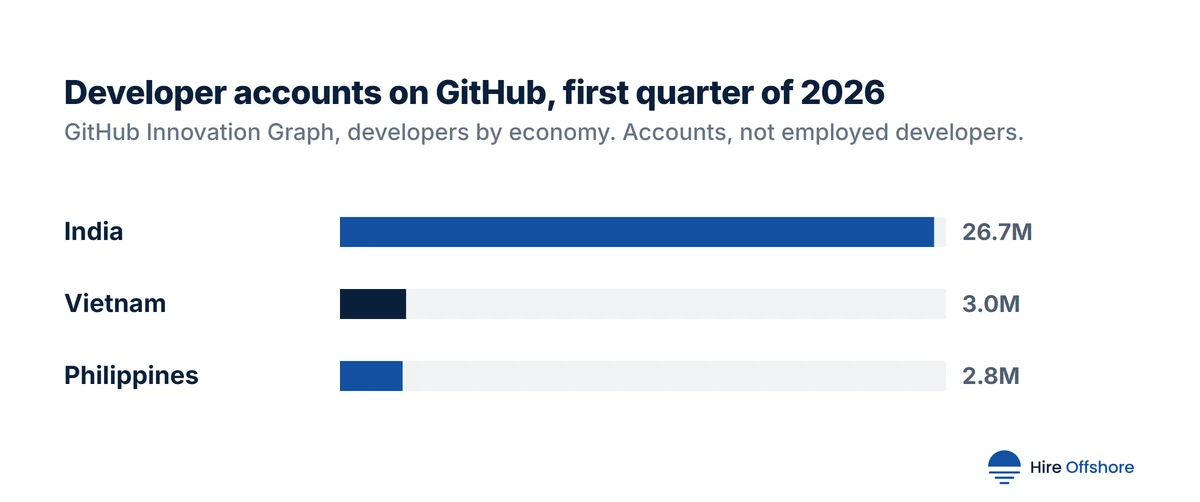
GitHub counted 26.7 million developer accounts in India in the first quarter of 2026, plus 3.0 million in Vietnam and 2.8 million in the Philippines. For a US company building an offshore team in Asia, those three countries hold most of the English-speaking engineering talent within a few hours of each other.
Finding people is seldom the hard part. The decisions that shape the next few years come before the first hire. Who employs the team? What does employment cost in each country? And how does the work get done when no standard local workday overlaps with a US one?
- There are four ways to run an offshore team in Asia: your own entity, a hiring partner that employs for you, freelancers, or a project vendor.
- A foreign-owned company selling into the Philippine market needs US$200,000 in paid-in capital, or US$100,000 if it qualifies for an exception.
- Employers pay 21.5% on top of salary in Vietnam and 12% into India's provident fund, and Philippine employers owe a 13th-month payment.
- A standard 9-to-6 day in Vietnam, the Philippines or India shares no hours with a US workday, so the overlap has to be built into the schedule.
Where an offshore team in Asia is usually based
US companies looking for full-time offshore developers in Asia most often compare Vietnam, the Philippines and India. The three differ more in scale and English than in cost.
| Vietnam | Philippines | India | |
|---|---|---|---|
| Developer accounts on GitHub, Q1 2026 | 2,972,715 | 2,815,527 | 26,727,004 |
| EF English Proficiency Index 2025 | 64th of 123 | 28th of 123 | 74th of 123 |
| Time zone | UTC+7 | UTC+8 | UTC+5:30 |
| Main tech hubs | Ho Chi Minh City, Hanoi, Da Nang | Manila, Cebu | Bengaluru, Hyderabad, Pune |
The developer counts come from the GitHub Innovation Graph, and they count accounts, not employed developers. The English ranks come from EF’s 2025 index for the Philippines, Vietnam and India.
India offers the largest pool by far, and the Philippines leads on English. Our Vietnam vs Philippines vs India comparison covers pay, holidays and which country suits which team in detail.
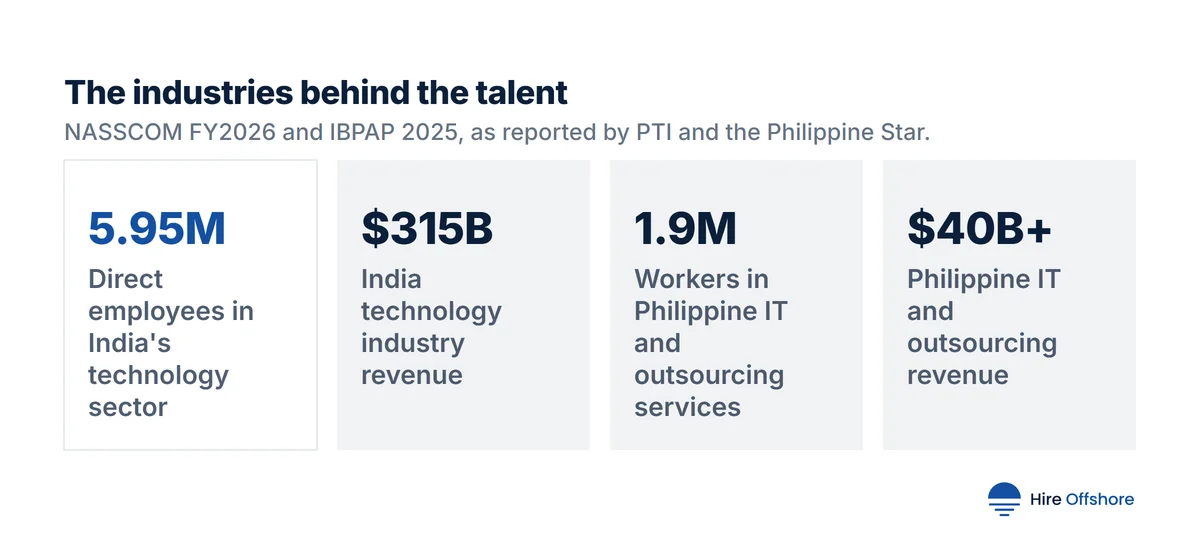
Both countries have large service industries behind the talent. NASSCOM puts India’s technology sector at 5.95 million direct employees and US$315 billion in revenue for fiscal 2026, as reported by PTI. The Philippine IT and business-process industry employed 1.9 million people in 2025 and passed US$40 billion in revenue, according to IBPAP figures in the Philippine Star.
Four ways to set up an offshore team in Asia
Choosing the employer is the decision that sets your costs, your speed and your legal exposure.
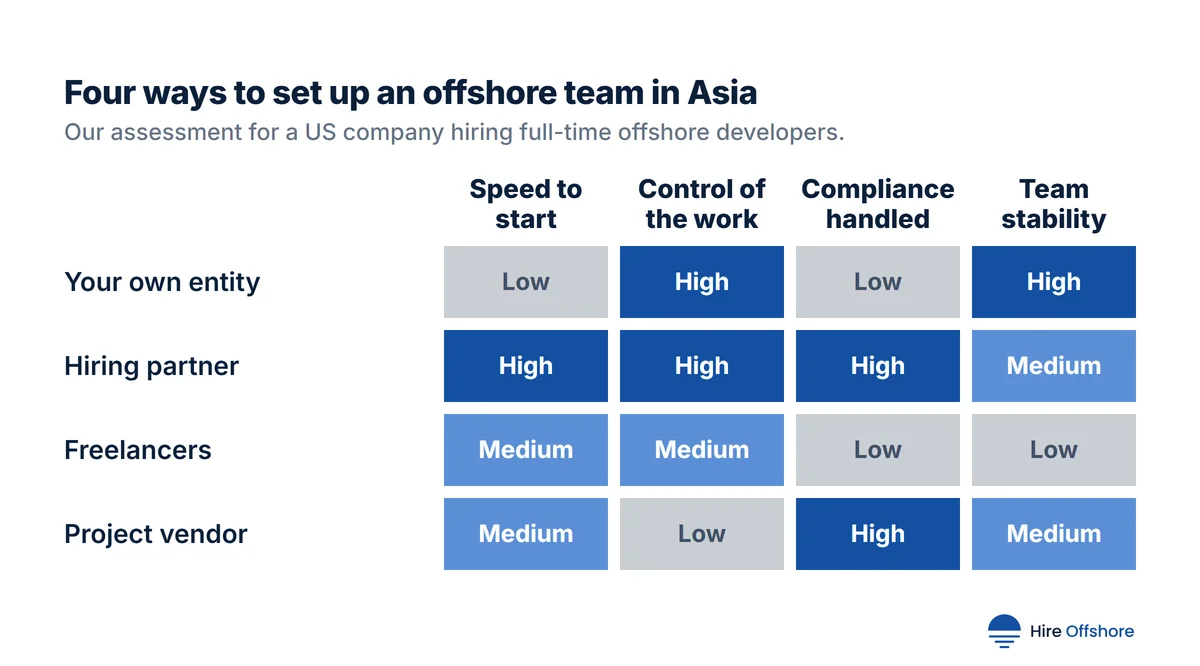
Your own entity. You register a company in the country, hire offshore developers onto its payroll and run local compliance yourself. It gives the most control and suits a large team that will stay in one country for years. It is also the slowest start, as the next section shows.
A hiring partner. A partner such as Hire Offshore employs the offshore developers in their country and runs payroll, contributions and leave. The offshore developers work only on your product and take direction from you. You can start within weeks and need no local company.
Freelancers. Each person contracts with you directly. It is quick for one or two people but harder to hold together as a team, and it raises questions about IP and worker classification. Our freelance vs full-time comparison covers both.
A project vendor. An outsourcing firm delivers an agreed scope with its own people and its own managers. It fits a defined project with an end date better than a product you keep building.
What your own entity takes, country by country
Setting up your own company is the route most US firms consider first and take last. The rules below are the main ones a US company meets in each country.
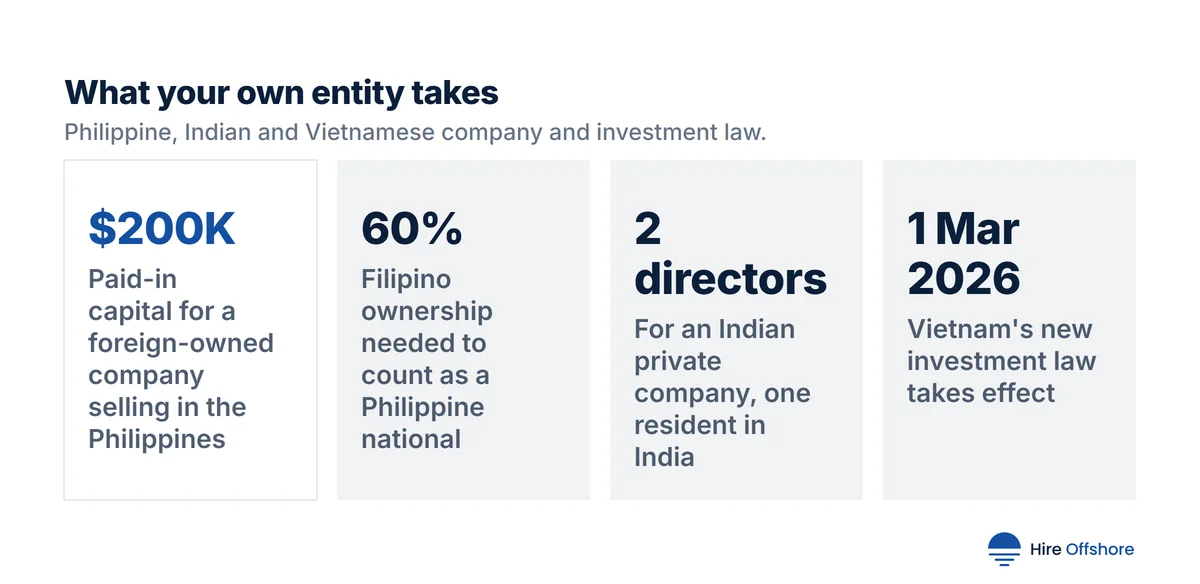
Philippines. A company counts as a Philippine national only if Filipinos own at least 60% of its voting stock, under Republic Act 7042. A small or medium foreign-owned company that sells into the Philippine market needs at least US$200,000 in paid-in capital. Republic Act 11647 lowers that to US$100,000 for a company that uses advanced technology, is an endorsed startup, or has at least 15 direct employees, most of them Filipino. Companies that export most of their output face looser ownership limits, so check how your entity will be classed before you register it.
India. A private limited company needs at least two directors, and at least one must have stayed in India for 182 days or more in the previous calendar year, under section 149 of the Companies Act 2013. The SPICe+ incorporation form bundles director IDs, tax numbers and provident fund and state insurance registration into one filing.
Vietnam. A foreign investor needs an investment registration certificate and an enterprise registration certificate. Under the Law on Investment 2025, in force from 1 March 2026, a foreign investor can obtain the enterprise certificate first, then open bank accounts and lease an office before the investment certificate arrives, as TWL Law Group explains in IFLR.
In all three, a company also needs a local bank account, payroll, tax filings and someone who knows the labor law. For a team of three to ten people, those fixed costs add a large share to the cost of each hire.
Your own entity
- Full control over hiring, pay and policy
- Capital, registration and local compliance before the first hire
A hiring partner
- Offshore developers employed in-country for you, working only on your product
- Shortlist in 24 hours and hire in 2 weeks, with no entity
Employer contributions in each country
Whoever employs the team pays these on top of salary. Through a hiring partner they sit inside the fee. With your own entity, you pay them yourself.
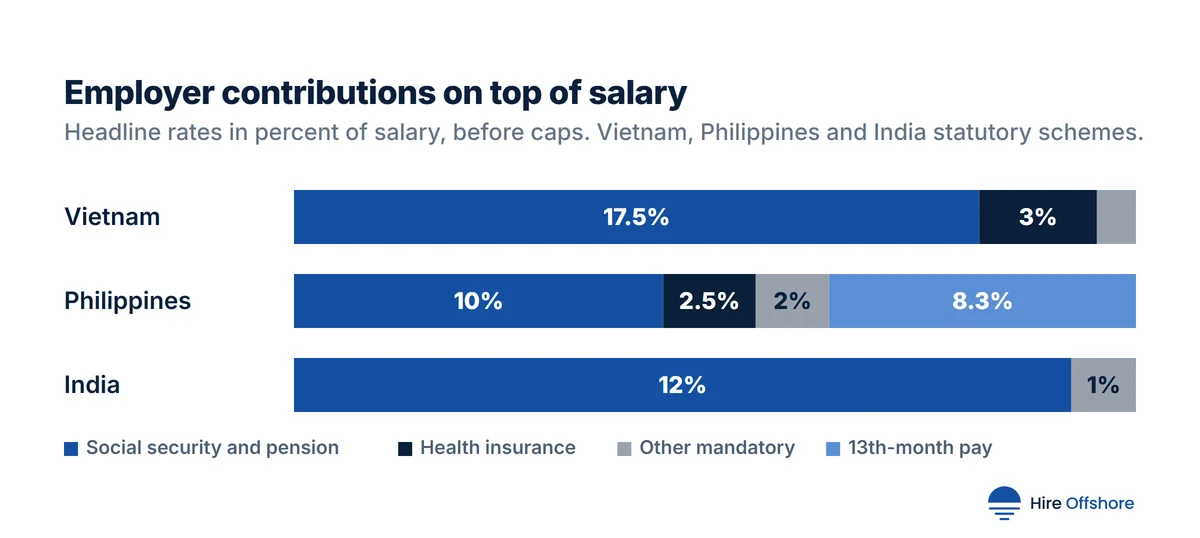
Vietnam. From 1 July 2025, employers pay 21.5% of salary: 17.5% into social insurance, 3% into health insurance and 1% into unemployment insurance, per EY Vietnam. Social and health insurance stop at VND 46.8 million a month, so the share falls for senior salaries.
Philippines. Employers pay 10% into the Social Security System on a monthly salary credit of PHP 5,000 to PHP 35,000, per Grant Thornton Philippines. PhilHealth is 5% of basic salary between PHP 10,000 and PHP 100,000 a month, per PhilHealth Advisory 2025-0002, and the employer pays half. Pag-IBIG adds 2% on up to PHP 10,000 of salary. Every rank-and-file employee is also owed a 13th-month payment of one-twelfth of annual basic pay by 24 December, under Presidential Decree 851.
India. Employers contribute 12% of wages to the provident fund: 3.67% to the fund and 8.33% to the pension scheme, plus 0.5% for insurance and 0.5% in administration charges. The wage ceiling for mandatory cover rose from INR 15,000 to INR 25,000 a month from 17 September 2026, per the EPFO. State insurance, at 3.25% for the employer, applies only to wages up to INR 21,000 a month, per the ESIC. Few developers earn that little, so it seldom applies.
India’s four Labour Codes took effect on 21 November 2025. Under them, gratuity is owed after five years for permanent staff and after one year for fixed-term staff, as KPMG India summarizes.
Time zones and working hours
Vietnam is UTC+7, the Philippines UTC+8 and India UTC+5:30. On a standard 9-to-6 day in each country, none of them shares a working hour with US Eastern or US Pacific time in October. The overlap has to be built in.
Most US companies agree a shifted schedule. A team in Manila working from 1pm to 10pm overlaps with the morning on the US West Coast. A team in Ho Chi Minh City that starts later overlaps with the end of the US East Coast day. Offshore developers who work a shifted schedule give 4 to 6 hours of overlap with a US workday, and we agree that schedule before the offer.
Shifted hours have rules too. In the Philippines, work between 10pm and 6am earns a night shift differential of at least 10% of the regular wage per hour, under Article 86 of the Labor Code. Plan the schedule so most of the day ends before 10pm, or budget for the extra pay.
Our guide to managing offshore developers covers overlap schedules, written handoffs and code review across time zones.
Holidays to plan around
Each country has its own peak. In Vietnam, the Lunar New Year (Tet) holiday takes up five of the 11 statutory paid days, and from 2026 Culture Day on 24 November is also a paid day off, as Vietnam News reports. Tet 2027 falls on 6 February.
The Philippines has 10 regular holidays and 8 special non-working days in 2026 under Proclamation 1006, with Holy Week from 2 to 4 April and a cluster around Christmas and New Year. In India, holidays vary by state, and Diwali falls on 8 November 2026.
A team based in one country shares one calendar, which makes release planning simpler. A team split across two countries seldom loses everyone on the same day, but it needs two calendars in the planning tool.
How to structure the team
Sources: Scrum Guide 2020; Hire Offshore.
Start with a small team in one country, three to five people with a senior offshore developer as lead. The Scrum Guide puts a team at 10 or fewer people, and past that point it is easier to run two teams than one large one.
Keep the product owner in the US at first, so someone with the customer context writes and accepts the work. Hire the lead a week or two before the others, so the repositories, review rules and handoff format exist when the rest arrive. Then grow the team one role at a time, using our guide on how to vet offshore developers for each hire.
For the cost side, our offshore vs onshore comparison prices a team of five in Asia against the same team in the US.
Hire offshore developers with Hire Offshore
We shortlist 6 to 8 vetted offshore developers in Vietnam, the Philippines or India within 24 hours and complete the hire in 2 weeks. We employ each offshore developer locally, so you need no entity in Asia. The monthly fee of $2,499 to $5,999 covers salary, statutory contributions, payroll and equipment, with no upfront cost and a 90-day replacement guarantee. See how it works, check pricing or send us the roles for your team.
FAQ
What is the best country in Asia for an offshore development team?
It depends on the team. India has by far the largest developer pool, with 26.7 million GitHub accounts. The Philippines ranks highest on English of the three, 28th of 123 on EF’s 2025 index. Vietnam sits between them, with 3.0 million GitHub accounts and a 64th-place English rank. Through Hire Offshore the fee is the same in all three, $2,499 to $5,999 a month.
Do I need a company in Asia to hire an offshore team?
No. A hiring partner or employer of record employs the offshore developers in their country and runs payroll and contributions, so you can hire without registering a company. Your own entity makes sense for a large, long-term team in one country.
How much capital does a foreign company need in the Philippines?
A small or medium foreign-owned company selling into the Philippine market needs at least US$200,000 in paid-in capital. That drops to US$100,000 for companies using advanced technology, endorsed startups, or companies with at least 15 direct employees, most of them Filipino.
What employer contributions apply to developers in Vietnam, the Philippines and India?
Vietnam: 21.5% of salary for social, health and unemployment insurance, capped for higher salaries. The Philippines: 10% for social security, half of a 5% PhilHealth premium, Pag-IBIG and a 13th-month payment. India: 12% to the provident fund and pension scheme, plus 1% in insurance and administration charges.
How do US companies handle the time difference with an offshore team in Asia?
With a shifted schedule. A standard day in Vietnam, the Philippines or India shares no hours with a US workday, so teams agree later working hours that give 4 to 6 hours of overlap, and move the rest of the communication into writing.