
 Vietnam
 The Philippines
 India
India
In June 2025 the US Justice Department said North Korean IT workers using stolen or fake identities had been hired by more than 100 US companies, and the FBI searched 29 suspected “laptop farms” in 16 states. Every one of those hires passed some kind of interview. Vetting an offshore developer starts with who they are, and only then moves on to what they can do.
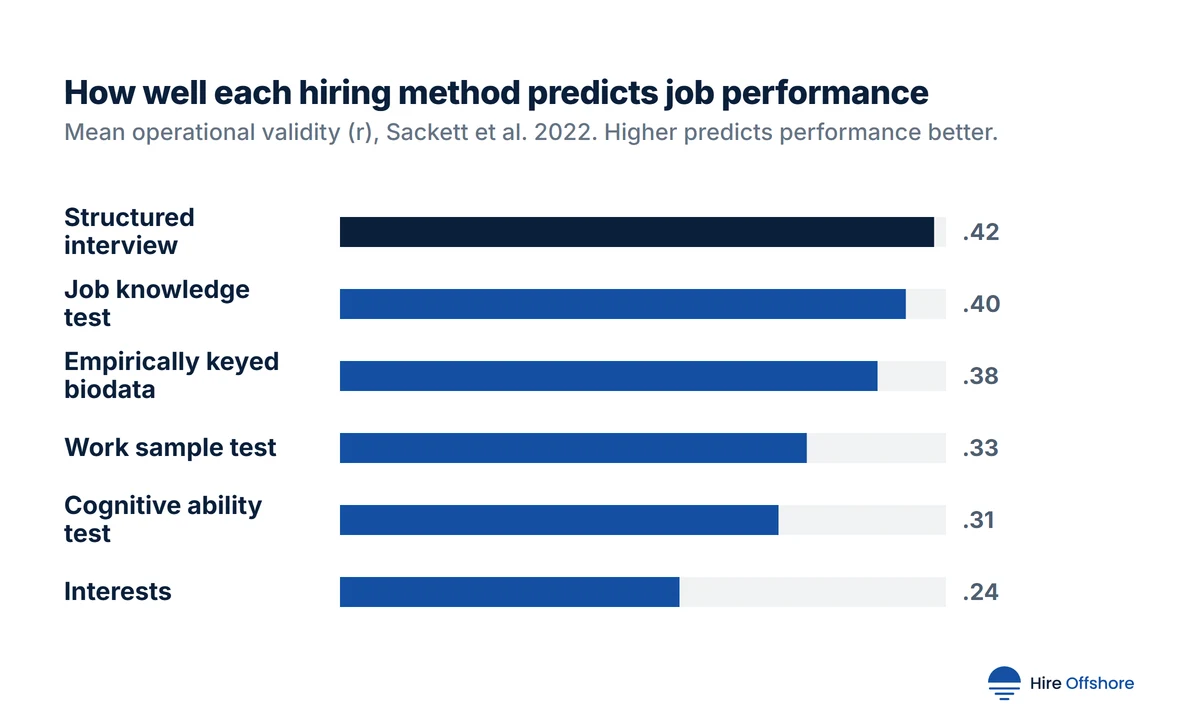
- A structured interview predicts job performance better than any other common hiring method, with a validity of .42 against .31 for a cognitive ability test.
- The FBI tells employers to require video, ask the candidate to point the camera out of a window, and ship laptops only to the address on the ID.
- In all three main offshore markets, English writing scores run ahead of speaking, by 64 points in the Philippines.
- Probation caps differ: 60 days for degree-level roles in Vietnam, 6 months in the Philippines, and whatever the contract says in India.
Verify identity before you test skills
The FBI’s July 2025 notice on North Korean IT workers is the most practical checklist for remote hiring that any government has published. Its recommendations for employers:
- Mandate video and ask that the background is not blurred or replaced.
- Ask the candidate to point the camera out of a window, then ask about the location they claim and the one on their ID.
- Ask them to wave a hand in front of their face, which can break AI-generated video.
- Cross-check photos, phone numbers and emails against social media, portfolio sites and payment platforms, and look for misspellings on ID documents.
- Ship equipment only to the address on the ID, and give no system access until the background check is complete.
An earlier FBI notice from January 2025 adds two patterns to look for: the same phone number (often a VoIP number) or email address appearing on resumes that claim to be different applicants, and face-swapping software used during video interviews. Its advice is to verify identity during interviewing, during onboarding and throughout employment, not once.
Source: US Department of Justice, 30 June 2025.
Vietnam and the Philippines each have a standard record check, and asking for one costs the candidate a short application:
- Philippines. An NBI clearance from the National Bureau of Investigation, booked online at clearance.nbi.gov.ph. Employment is one of the listed purposes.
- Vietnam. A judicial record certificate. Since the amended Law on Judicial Records took effect on 1 July 2026, citizens can apply through the VNeID app and the standard processing time is 5 working days, down from 10.
Ask for these at the offer stage. A candidate who stalls on a record check that takes a week is giving you an answer.
Run a structured interview, not a conversation
Once identity holds, the next question is which test tells you most about future performance. The best evidence comes from a 2022 re-analysis by Paul Sackett and colleagues in the Journal of Applied Psychology. It corrected decades of meta-analyses that had overstated how well hiring methods work, and it changed the ranking. As SIOP’s summary puts it, the structured interview came out on top.
A structured interview has three parts that a friendly video call lacks:
- The same questions for every candidate, written from the job description before the first interview.
- A scoring guide for each question, with what a weak, average and strong answer looks like.
- Independent scores, recorded by each interviewer before the panel talks about the candidate.
For an offshore developer, write the questions around the work they will do. A backend role might ask how they would add an index to a busy production table without downtime, or what they check first when an API’s latency doubles overnight.
Situational questions (“what would you do if…”) and past-behavior questions (“tell me about a time you…”) both work. What matters is that each candidate answers the same ones and your interviewers score them on the same scale.
Test the work itself
Job knowledge tests score .40 and work sample tests .33 in the same analysis. For software roles they are easy to build, because the job produces artifacts you can recreate.
A stack-specific knowledge test. Short questions on the framework and version they will use: Laravel queues, Spring transaction boundaries, React rendering. Keep it timed and closed to outside help, and make it about the decisions a working offshore developer makes, not syntax trivia.
A work sample. Pick one of these, sized to 2 to 4 hours:
- Fix a real bug in a small repository you prepare, with a failing test that defines “done”.
- Review a pull request you have seeded with three problems: one bug, one security issue, one maintainability issue.
- Extend a small feature and write the tests for it.
The pull request review is the most useful for offshore hiring. It shows code judgment and written English in one exercise, and code review is where much of a distributed team’s communication happens.
A live follow-up. Spend 30 minutes walking through the work sample on a call. Ask why they chose one approach over another and what they would change with more time. A candidate who submitted work they did not write cannot explain it.
Schedule the live parts inside the candidate’s working day. Manila and Ho Chi Minh City are 11 to 12 hours ahead of New York in summer, so a test set for 10am Eastern lands at 9pm or 10pm for the candidate, and you end up grading fatigue. The nearshore vs offshore cost comparison maps the shared hours city by city.
Test English skill by skill
Country averages are a starting point. The EF English Proficiency Index 2025 ranks the Philippines 28th of 123 countries, Vietnam 64th and India 74th. The scores by skill, published on each country page, show where the risk sits.
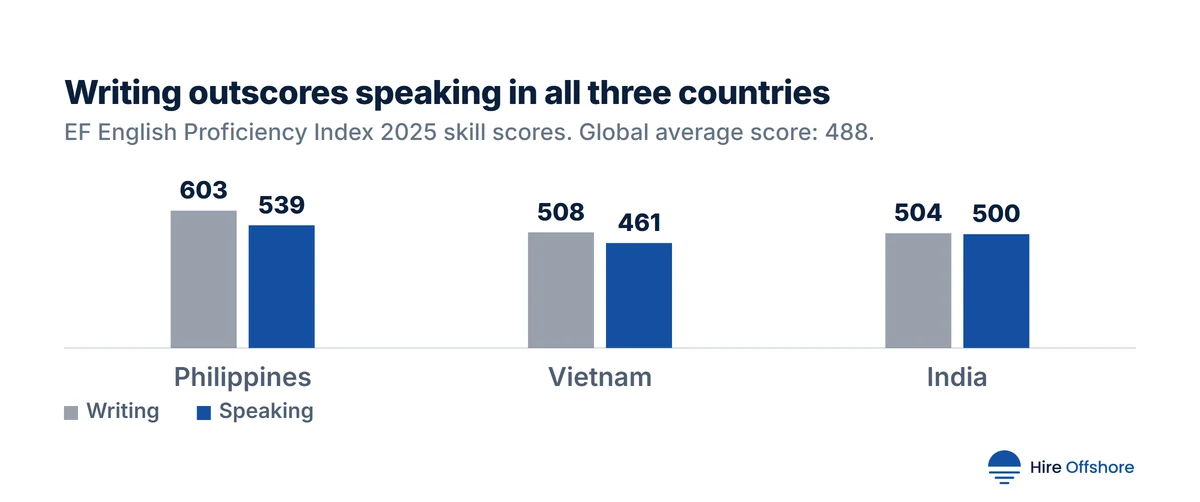
Writing beats speaking in all three. The gap is widest in the Philippines (64 points) and Vietnam (47), and close to even in India, where listening is the weakest skill at 457. In practice, an offshore developer may write a clear pull request description and still struggle in a fast standup.
So test the two separately:
- Written: the pull request review above, plus a short async task such as a status update on a blocked ticket.
- Spoken: 10 minutes of unscripted technical conversation in the structured interview, where the candidate explains a past project and answers follow-up questions.
The Council of Europe’s CEFR scale is the clearest bar to score against. At C1, a speaker “can express him/herself fluently and spontaneously without much obvious searching for expressions.” That is the level where standups and code review run without a translator in the loop. Vietnamese offshore developers on average sit in EF’s Moderate band, so the individual test matters most there; our Vietnam page covers the rest of that market.
Check how they work on a distributed team
Technical skill and English do not tell you whether an offshore developer will raise a blocker at 9am their time or sit on it until your standup. Ask past-behavior questions about remote work, scored like the rest of the structured interview:
- “Tell me about a time you were blocked and the person who could unblock you was asleep. What did you do?”
- “Show me the last written handover you wrote. What did the reader need from it?”
- “Describe a disagreement with a reviewer on a pull request. How did it end?”
A strong answer names the tool and the timing: a ticket comment with logs before signing off, a short Loom, a decision record. A weak one stays general.
Agree the working schedule before the offer. An offshore developer working a shifted day gives a US team 4 to 6 hours of overlap; how it works shows where that sits in our process.
Use references and probation as the last checks
Reference calls work best when they are as structured as the interview. Ask the former manager the same three questions you scored: technical judgment, communication in English, and what the candidate did when a blocker held up their work. Then ask whether they would hire the person again.
Probation is the final stage of vetting, and its length is set by local law.
Vietnam
- 60 days maximum for roles needing a junior college degree or above
- Pay at least 85% of the agreed salary; either side can end it without notice
Philippines
- 6 months maximum
- The standards must be made known at hiring, or the employee counts as regular
Vietnam’s rules are in Articles 25 to 27 of the 2019 Labour Code, and the code allows only one probation period per job. In the Philippines, the Labor Code lets an employer end probation when the employee fails “reasonable standards made known by the employer to the employee at the time of his engagement”, so write the standards into the offer. India has no specific probation law: the employment contract sets the period, and courts reject one that is unreasonably long.
Write the probation goals as tasks: ship a given feature, close a set number of tickets, lead one code review. Then score them like the interview.
A vetting checklist for offshore developers
| Stage | What to check | Red flag |
|---|---|---|
| Identity | Live video, ID matches face and location, record check | Camera off, blurred background, delivery address differs from ID |
| Knowledge test | Timed questions on the exact stack and version | Strong resume, weak answers on daily decisions |
| Work sample | Bug fix, PR review or small feature, 2 to 4 hours | Cannot explain their own submission on the follow-up call |
| Structured interview | Same questions, scoring guide, independent scores | Interviewers compare notes before scoring |
| English | Written task and 10 minutes of live technical talk | Good writing, cannot follow a fast spoken question |
| Remote work | Past-behavior questions on blockers and handovers | General answers with no tool or timing |
| References and probation | Structured reference calls, written probation goals | Former manager would not hire again |
Hire offshore developers with Hire Offshore
Each offshore developer we put forward has passed three checks: a stack-specific technical assessment, an English test at C1 or above, and a behavioral interview on ownership and distributed work. We send a shortlist of 6 to 8 within 24 hours in Vietnam, the Philippines or India, you run your own technical round, and the hire completes in 2 weeks.
If the placement does not work out in the first 90 days, we replace the offshore developer at no extra cost. Fees run $2,499 to $5,999 a month, all-in; see pricing or send us the role.
FAQ
How long should vetting an offshore developer take?
The tests themselves take about a day of the candidate’s time: a short knowledge test, a 2 to 4 hour work sample, and two calls. Record checks add up to a week; Vietnam’s judicial record certificate takes 5 working days as standard.
Which single check matters most?
If you only run one, run a structured interview. It had the highest validity of any method in the 2022 Sackett re-analysis, at .42, and it costs nothing but preparation time.
Can a recruiter’s vetting replace my own interview?
No. Use it to cut the list, then run your own structured interview and work sample on the shortlist, because only your team knows the codebase and the way it works.