
 Vietnam
 The Philippines
 India

A freelance developer in Vietnam, the Philippines or India asks about $20 an hour on Freelancer.com, the same median in all three countries. A full-time offshore developer through Hire Offshore costs $14 to $35 an hour, all-in. On price alone the two routes overlap.
The real differences sit around the rate: who pays the platform, who owns the code, whether the contract survives a labour inspector, and whether the developer is still there in month nine.
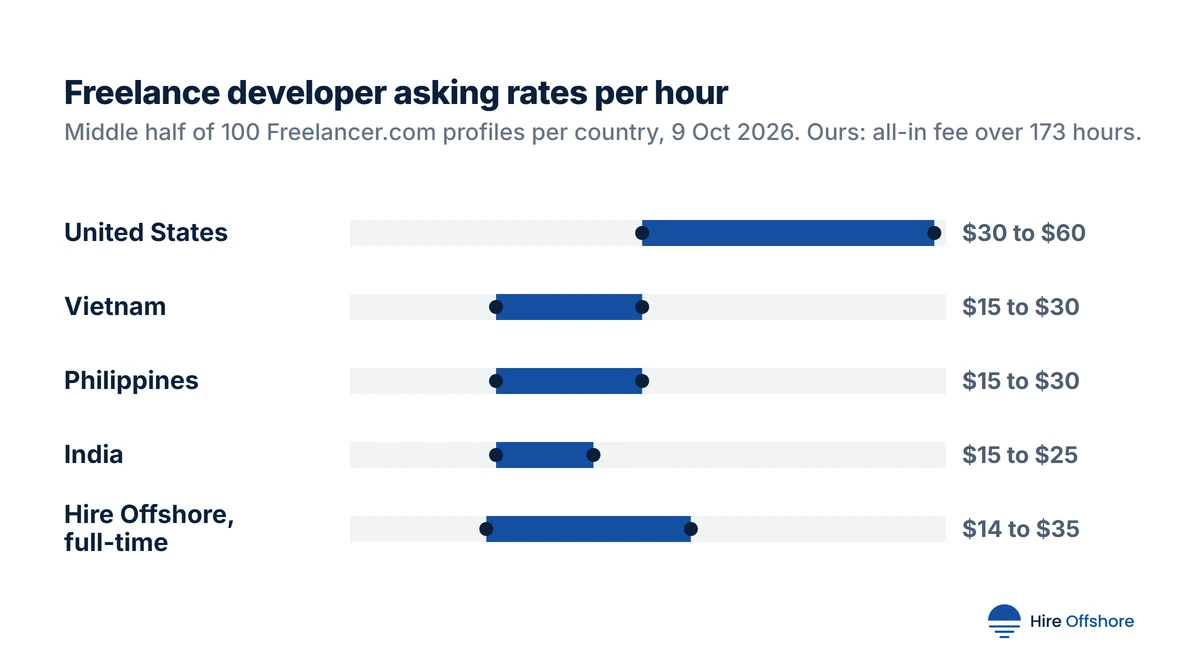
- The middle half of Vietnamese, Filipino and Indian freelance developers on Freelancer.com ask $15 to $30 an hour, against $30 to $60 in the US.
- Upwork adds a 5% client fee on its Basic plan and takes 0% to 15% from the freelancer, so up to $20 of every $105 a client pays goes to the platform.
- Under US copyright law, custom software a contractor writes is usually not a work made for hire. Without a signed assignment, the freelancer keeps it.
- Vietnam's Labour Code treats any agreement on paid work, salary and supervision as an employment contract, whatever its title.
What freelance offshore developers charge by the hour
To see what the market asks, we read Freelancer.com’s public directory on 9 October 2026. For each country we took the first 100 profiles with an hourly rate that list PHP, Java, Python, Node.js, Laravel, React or full-stack development, in the directory’s default order. These are asking rates in US dollars, before platform fees.
| Country | 25th percentile | Median | 75th percentile | Agency accounts in sample |
|---|---|---|---|---|
| United States | $30 | $48 | $60 | 48 of 100 |
| Vietnam | $15 | $20 | $30 | 21 of 100 |
| Philippines | $15 | $20 | $30 | 12 of 100 |
| India | $15 | $20 | $25 | 60 of 100 |
Three points stand out. The median is identical across the three offshore countries. The spread is narrow: half of all offshore profiles sit within $10 to $15 of each other. And the US median, $48, is 2.4 times the offshore median, which is the gap that draws buyers to offshore freelance developers in the first place. Our nearshore vs offshore cost comparison shows the same gap at the salary and vendor level.
What the platform takes
The rate on a profile is not what the client pays, or what the freelance developer receives. Both sides pay the marketplace.
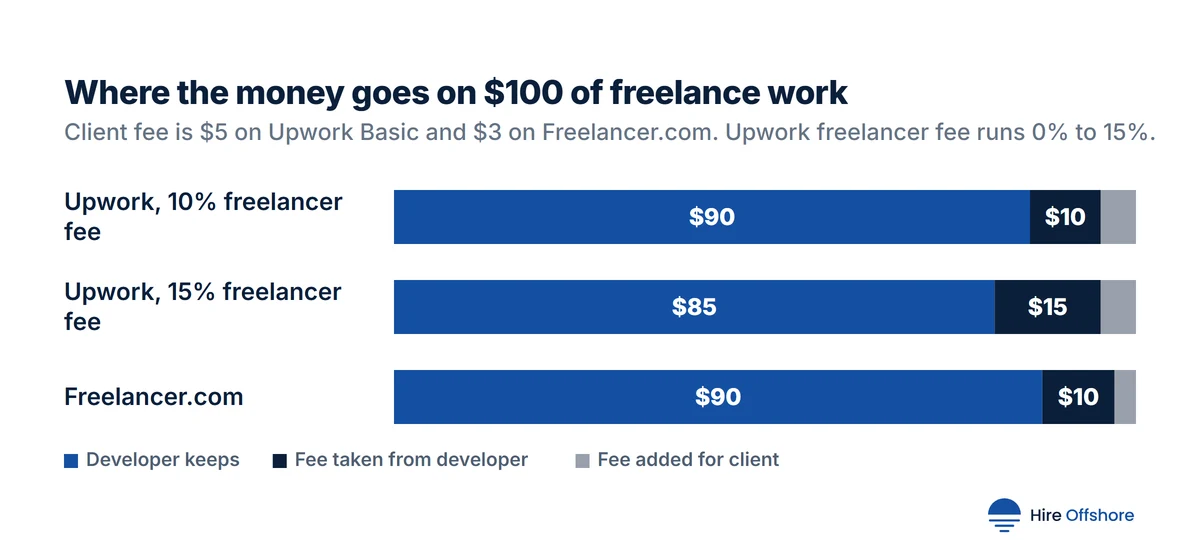
Upwork. On the free Basic plan, Upwork’s client pricing page adds a 5% Marketplace fee to every payment, cut to 3% for eligible US clients paying from a bank account. Business Plus raises it to 10%. Each new contract also carries a one-time Contract Initiation Fee of $0.99 to $14.99. On the other side, the Freelancer Service Fee ranges from 0% to 15% per contract and is fixed once the contract starts.
Freelancer.com. The fees page lists 3% for employers on each hourly payment and 10% for freelancers.
The freelancer’s fee matters to the buyer too. A freelance developer who wants to take home $20 an hour on a 10% fee has to bill $22.22, the worked example Upwork gives in its own help article. Platform fees come out of the rate the client sees, and the client pays its own fee on top.
A full-time offshore developer through Hire Offshore has no marketplace in the middle. The monthly fee of $2,499 to $5,999 covers salary, payroll, equipment and our fee, with no hourly billing and no timesheets.
A full month, priced both ways
Hourly rates hide the comparison most buyers need: one developer, full-time, for a month. At 173 working hours, the offshore freelance median comes to $3,460 before fees and $3,633 once Upwork’s 5% client fee is added.
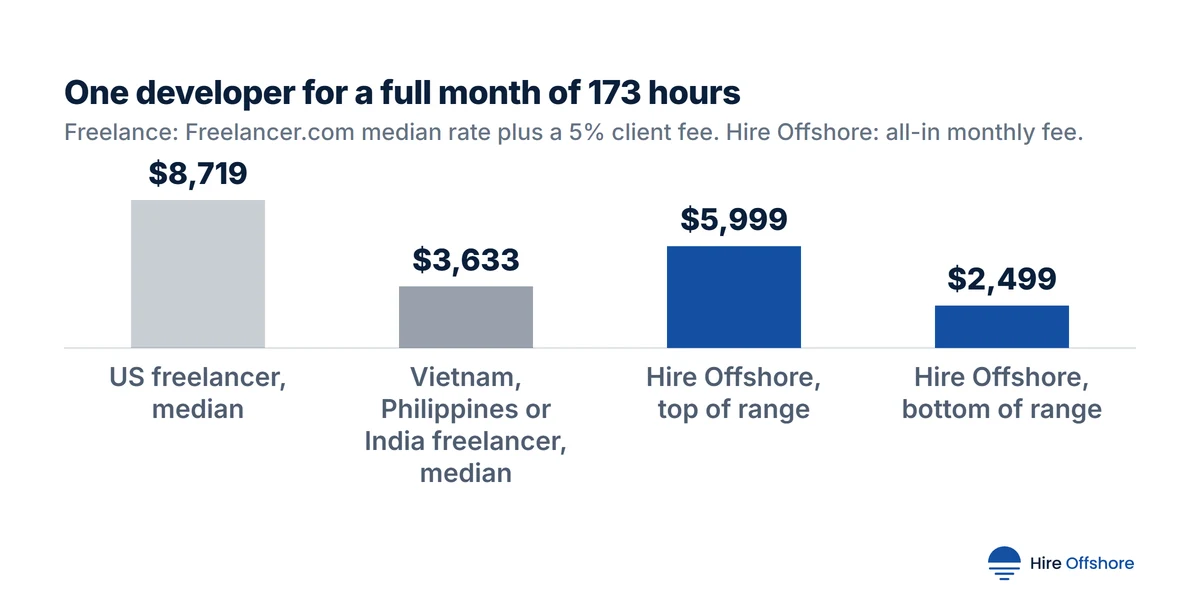
On cash alone, a median offshore freelance developer sits inside the Hire Offshore range. The difference is what the number buys.
The freelance figure assumes the developer bills all 173 hours to you. It includes no equipment, no replacement if the hire fails, and no employer standing behind the contract. The full-time figure includes all three, and the offshore developer works only for you.
Offshore freelance developer
- About $3,633 a month at the median rate, if billed full-time
- Platform fees on both sides; the developer can take other clients
Full-time offshore developer
- $2,499 to $5,999 a month, all-in
- Employed, dedicated to one team, 90-day replacement guarantee
Who owns the code
This is the risk that costs the most when it goes wrong, and it is the least visible at hiring time. The rules differ by country, and none of what follows is legal advice: take a contract to a lawyer in each country involved.
United States. The US Copyright Office’s Circular 30 sets out the two ways a work becomes a “work made for hire”, owned by the hiring party from the start. The first is a work prepared by an employee within the scope of employment. The second covers commissioned works, but only in nine categories, such as a contribution to a collective work or an instructional text, and only with a signed written agreement.
Custom software built by an independent contractor rarely fits one of those nine categories. Without a signed assignment of copyright, the freelance developer keeps it.
The Philippines. Section 178 of the Intellectual Property Code gives the employer the copyright in work an employee creates as part of regularly assigned duties. For a commissioned work, the person who paid owns the work itself, but the copyright stays with the creator unless there is a written stipulation to the contrary.
India. Under Section 17 of the Copyright Act, 1957, the author is the first owner of copyright. The exception is a work made in the course of employment under a contract of service, where the employer is the first owner unless they agree otherwise. A freelance developer works under a contract for services, so the default favours the developer.
The pattern is the same in all three: employment moves code ownership to the employer by default, and a freelance arrangement does not.
With a freelance developer, the protection is a written IP assignment, signed before work starts, covering everything delivered, including pre-existing code they reuse. Platform terms add their own layer, so read the assignment clause in the platform’s user agreement as well as your own contract.
Misclassification: when a freelancer counts as an employee
A freelance developer who works 40 hours a week for one client, on that client’s tools, under that client’s direction, can start to look like an employee to a labour authority. Each country has its own test.
Vietnam. Article 13 of the 2019 Labour Code defines an employment contract as an agreement on a paid job, salary, working conditions and each party’s rights. It then adds that a document with a different name is also an employment contract if it covers the paid job, salary, and management and supervision by one party.
A “service agreement” with fixed monthly pay and daily direction can meet that test, and an employment contract brings social insurance, leave and notice rules with it. Our Vietnam page lists those.
The Philippines. Courts apply a four-fold test: who selected and engaged the worker, who pays wages, who can dismiss, and who controls the means and methods of the work. ACCRA Law’s guide to individual contractors calls control “the most important element”, and notes that approving or rejecting the output is not, on its own, control over how the work gets done.
If an arrangement fails the test, the firm warns, the principal can owe back wages and benefits for at least the three-year prescriptive period, plus unpaid SSS, PhilHealth and Pag-IBIG contributions. A foreign company found to be an employer can also face the question of doing business in the Philippines without a licence. The Philippines page covers the 13th-month pay and contributions that employment carries.
India. The four labour codes took effect on 21 November 2025, according to the government’s Press Information Bureau. The Code on Social Security defines gig work, platform work and aggregators for the first time, and requires aggregators to contribute 1% to 2% of annual turnover, capped at 5% of what they pay gig and platform workers. Fixed-term employees now get benefits equal to permanent staff and become eligible for gratuity after one year. The India page has the provident fund and leave rules.
The common thread: the more a freelance arrangement looks like a job, with fixed hours, one client and day-to-day direction, the weaker the “contractor” label becomes. Short, defined projects with a deliverable fit freelance work. A permanent seat on your team is the hard case.
Retention and commitment
A freelance developer runs a business with several clients, and a better-paying contract elsewhere is a normal reason to end yours. Platform contracts can be closed by either side, and there is no notice period unless your contract sets one. Hourly billing also means hours can shrink when another client’s deadline lands.
Full-time employment changes the incentives on both sides. The offshore developer has one employer, a salary, statutory leave and, in Vietnam, a 45-day notice period on a permanent contract. Across our placements, 92% of offshore developers stay with their team. When a hire does not work out in the first 90 days, we replace the offshore developer at no extra cost.
Commitment also shows up in the working day. A full-time offshore developer agrees a schedule before the offer, with 4 to 6 hours of overlap with a US workday. Our guide to managing offshore developers covers how teams run that overlap once the hire starts.
When each one fits
A freelance developer fits when
- The work is a defined project with a clear end: a migration, a prototype, a fixed set of features.
- You need a niche skill for weeks, not a permanent seat.
- You can write the IP assignment and acceptance criteria before work starts.
- Hours will vary month to month, and paying only for hours used matters more than continuity.
A full-time offshore developer fits when
- The role is ongoing product work, where knowledge of your codebase compounds.
- The developer will sit in your standups, your repositories and your on-call rota.
- You want code ownership settled by employment rather than by contract drafting.
- You are building a team of several developers, where turnover and onboarding costs multiply.
Some teams use both: full-time offshore developers for the core product and a freelance developer for short, specialised projects around it. Whichever route you take, vet the person the same way. Our guide on how to vet offshore developers sets out the checks.
Hire offshore developers with Hire Offshore
We shortlist 6 to 8 vetted offshore developers from Vietnam, the Philippines or India within 24 hours and complete the hire in 2 weeks. The monthly fee of $2,499 to $5,999 covers salary, payroll, equipment and employment, with no upfront cost and a 90-day replacement guarantee. See how it works, check pricing or send us the role.
FAQ
Is a freelance offshore developer cheaper than a full-time one?
Not by much, once fees and hours are counted. The median Vietnamese, Filipino or Indian freelance developer on Freelancer.com asks $20 an hour, about $3,633 for a full month with Upwork’s 5% client fee. A full-time offshore developer through Hire Offshore costs $2,499 to $5,999 a month, including salary, employment and equipment.
Who owns code written by a freelance developer?
By default, often the freelance developer. In the US, custom software from a contractor is usually not a work made for hire; in the Philippines and India, copyright in commissioned work stays with the creator unless a written agreement says otherwise. Get a signed IP assignment before work starts.
Can a long-term freelance developer be treated as an employee?
Yes. Vietnam’s Labour Code treats any agreement covering paid work, salary and supervision as an employment contract, whatever it is called, and Philippine courts look at who controls how the work is done. A freelance developer working full-time hours under your direction is the riskiest case.
What fees does Upwork charge clients?
On the Basic plan, a 5% Marketplace fee on every payment (3% for eligible US clients paying by bank account), plus a one-time Contract Initiation Fee of $0.99 to $14.99 per contract. Business Plus charges 10%.