
 Vietnam
 The Philippines
 India
India
One extra hour of time difference cut real-time communication between colleagues by 11% in a 2024 study of a Fortune 100 company published in Organization Science. That is the strongest case for a nearshore team.
The case for offshore is the price gap below. It is wide enough to pay for a shifted schedule and still spend well under half of a nearshore salary.
- The median US software developer earns $135,980 a year, and benefits add 44.5% on top of wages for US professional staff.
- Polish employers pay 19.21% to 22.41% of gross salary into ZUS and state funds, on top of pay.
- Vietnam's 21.5% employer social insurance stops at a salary cap of about $1,806 a month, so the levy on a senior developer tops out near $388.
- The Philippines ranks 28th of 123 on EF's English index, ahead of Brazil at 75th and Mexico at 103rd.
What a software engineer earns, country by country
The cleanest like-for-like comparison is Levels.fyi, which reports median total compensation for the same “Software Engineer” title in every country. Read on 29 September 2026 and converted at that day’s exchange rate, the medians fall into three bands: the US near $196,000, nearshore Latin America and Eastern Europe between $35,000 and $71,000, and Vietnam and the Philippines between $12,600 and $15,000.
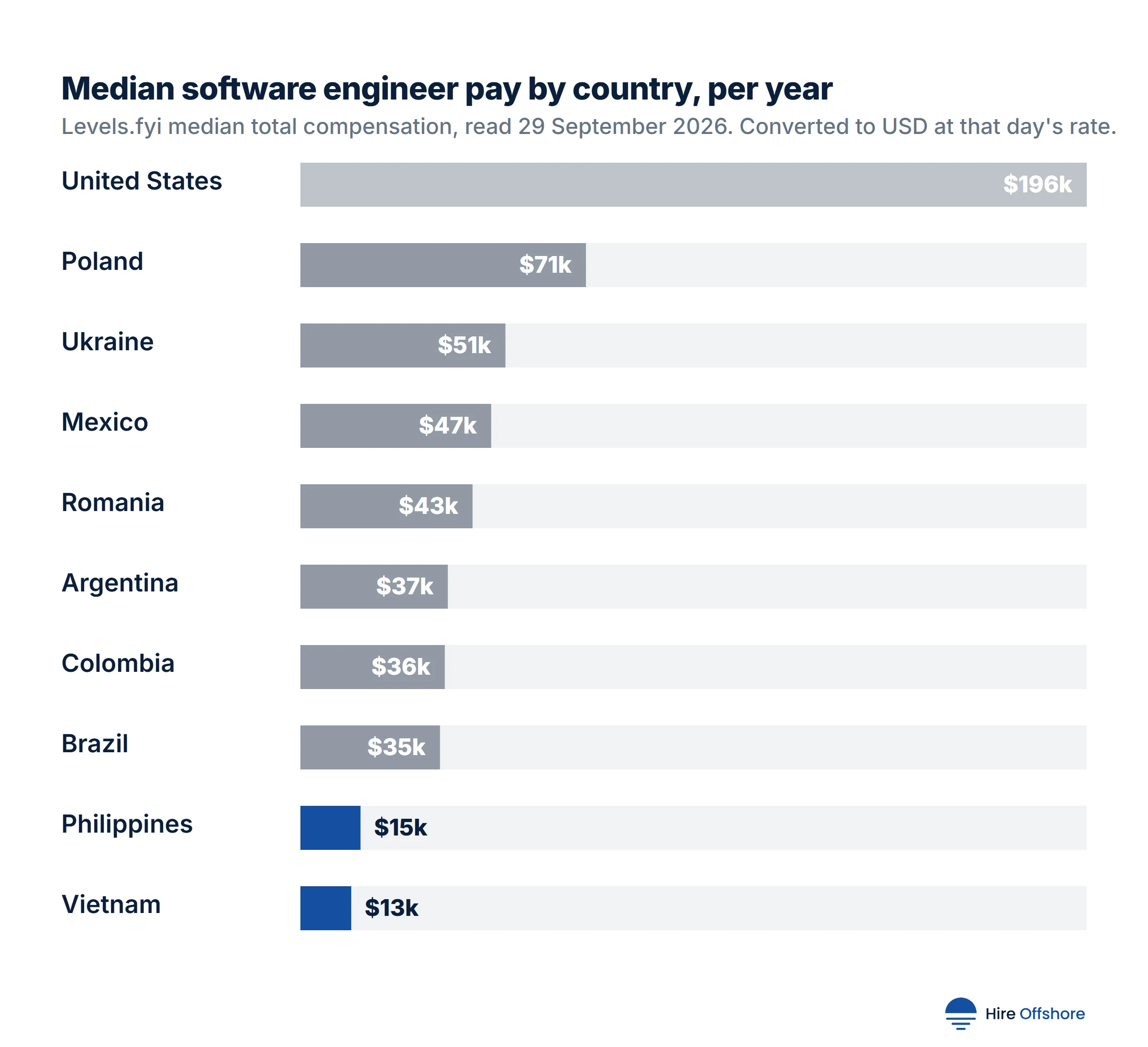
| Country | Median total pay (USD a year) | EF English rank (of 123) | UTC offset in July |
|---|---|---|---|
| United States | $195,500 | n/a | UTC-4 (New York) |
| Poland | $70,988 | 15 | UTC+2 |
| Ukraine | $50,975 | 45 | UTC+3 |
| Mexico | $47,427 | 103 | UTC-6 |
| Romania | $42,799 | 11 | UTC+3 |
| Argentina | $36,659 | 26 | UTC-3 |
| Colombia | $35,897 | 76 | UTC-5 |
| Brazil | $34,704 | 75 | UTC-3 |
| Philippines | $14,946 | 28 | UTC+8 |
| Vietnam | $12,643 | 64 | UTC+7 |
Local surveys land in the same place. Poland’s Just Join IT salary report puts the senior B2B median at PLN 24,780 a month, about $6,446. Vietnam’s ITviec salary report puts the full-stack median at VND 37.25 million a month, about $1,437. In the Philippines, the statistics office’s 2024 wage survey found software developers averaging PHP 66,180 a month, about $1,059, as BusinessMirror reported.
What vendors charge by the hour
Outsourcing firms add margin, bench time and management on top of salary, so their rates tell you what a buyer actually pays. Accelerance’s 2026 rate guide, based on its partner firms, puts senior developers at $60 to $75 an hour in Latin America and $64 to $76 in Central and Eastern Europe. Its Asia band, $31 to $41, comes from India, Pakistan and Bangladesh.
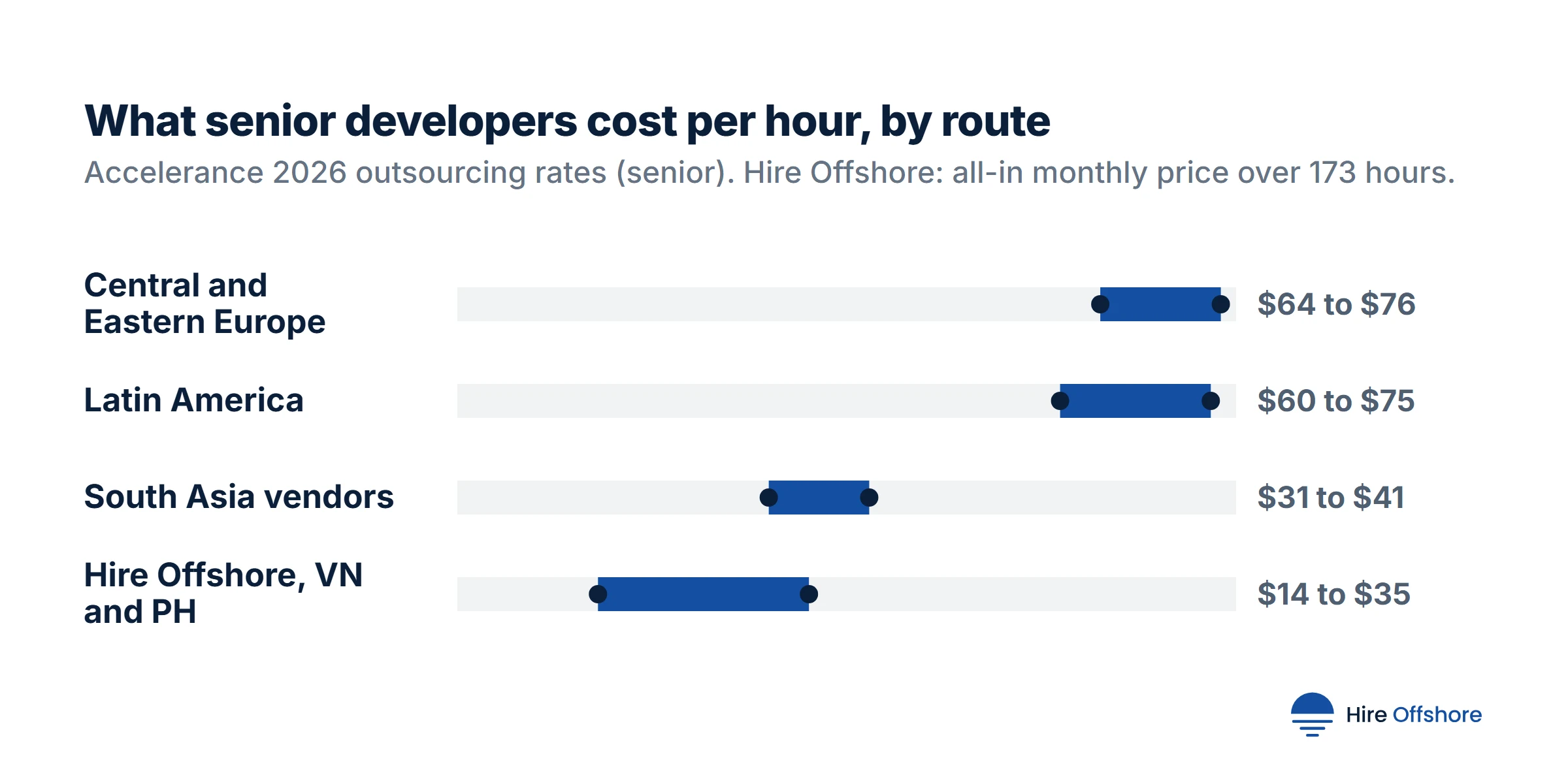
Set those rates against the US itself. The Bureau of Labor Statistics puts the median US software developer at $65.38 an hour in wages. A senior nearshore vendor rate sits at or above that line, because the vendor’s overhead replaces the US employer’s.
A full-time offshore developer through Hire Offshore costs $2,499 to $5,999 a month, all-in. Spread over 173 working hours, that is $14 to $35 an hour, with salary, payroll, equipment and our fee inside the number.
Employer costs on top of salary
Salary is only part of what an employer pays. The share that comes on top differs by country, and in Vietnam and the Philippines it is capped at low salary levels.
Sources: BLS ECEC June 2026, PwC tax summaries, EY Vietnam, SSS Circular 2024-006.
United States. In the BLS Employer Costs for Employee Compensation release for June 2026, wages make up 69.2% of total compensation for private-sector professional workers. The other 30.8% is benefits, which adds 44.5% on top of every dollar of pay.
Mexico. PwC’s tax summary lists employer social security up to MXN 227,286 a year, 5% for the housing fund, 2% for retirement, a state payroll tax of 3% to 4% in Mexico City, and profit sharing of 10% of adjusted taxable income.
Poland. Employer ZUS and fund contributions total 19.21% to 22.41% of gross pay, per PwC. Many senior Polish developers bill on B2B contracts instead, which moves their social insurance into their own invoice.
Vietnam. Employers pay 21.5% into social, health and unemployment insurance, but only on salary up to VND 46.8 million a month, according to EY Vietnam. On a senior salary the levy stops growing at about $388 a month. Our Vietnam hiring page covers the rest of the employment rules.
Philippines. Employers pay 10% to SSS on a monthly salary credit capped at PHP 35,000, 2.5% to PhilHealth, and a mandatory 13th-month salary under Presidential Decree 851. The 13th month adds one-twelfth, or 8.33%, to annual base pay. The Philippines page lists leave and notice rules.
Time zones: what nearshore buys
Overlap is where nearshore earns its price. The same Organization Science study found that one hour of added time difference removed 19% of shared business hours, which is why the communication drop was so steep.
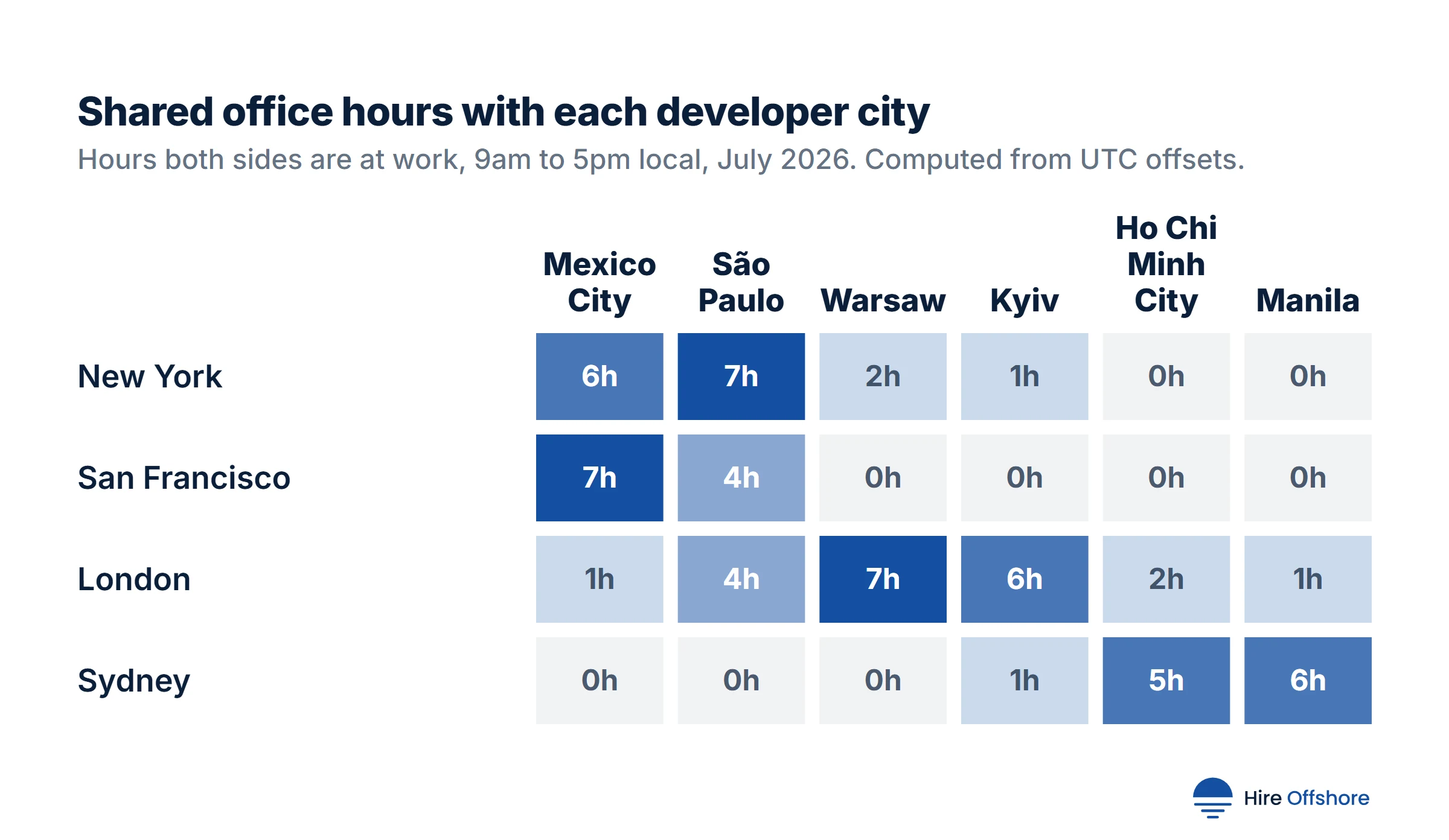
The pattern splits by buyer:
- US companies share 4 to 7 hours with Latin American cities and nothing with Vietnam or the Philippines on a standard day.
- UK companies share 6 to 7 hours with Warsaw and Kyiv, and 1 to 2 with Ho Chi Minh City and Manila.
- Australian companies share 5 to 6 hours with Vietnam and the Philippines and almost none with any nearshore market.
Overlap also moves during the year, because only some of these countries change their clocks. The US runs daylight saving from 8 March to 1 November 2026, the UK from 29 March to 25 October, and Sydney moves to daylight time on 4 October. Mexico dropped daylight saving in 2022, as its Energy Ministry notes, Brazil stopped in 2019, and Vietnam and the Philippines have never used it. A New York to Mexico City gap is 2 hours in July and 1 hour in January. A London to Manila gap is 7 hours in July and 8 in January, which erases the last shared hour.
For a US team, offshore works when the developer runs a shifted day. We agree the schedule before the offer, and our offshore developers overlap 4 to 6 hours with a US workday. How it works covers that step.
English: nearer is not always easier
Distance and English ability do not line up. The EF English Proficiency Index 2025 scores 123 countries, and the Philippines, at 569, sits above every Latin American market except Argentina.
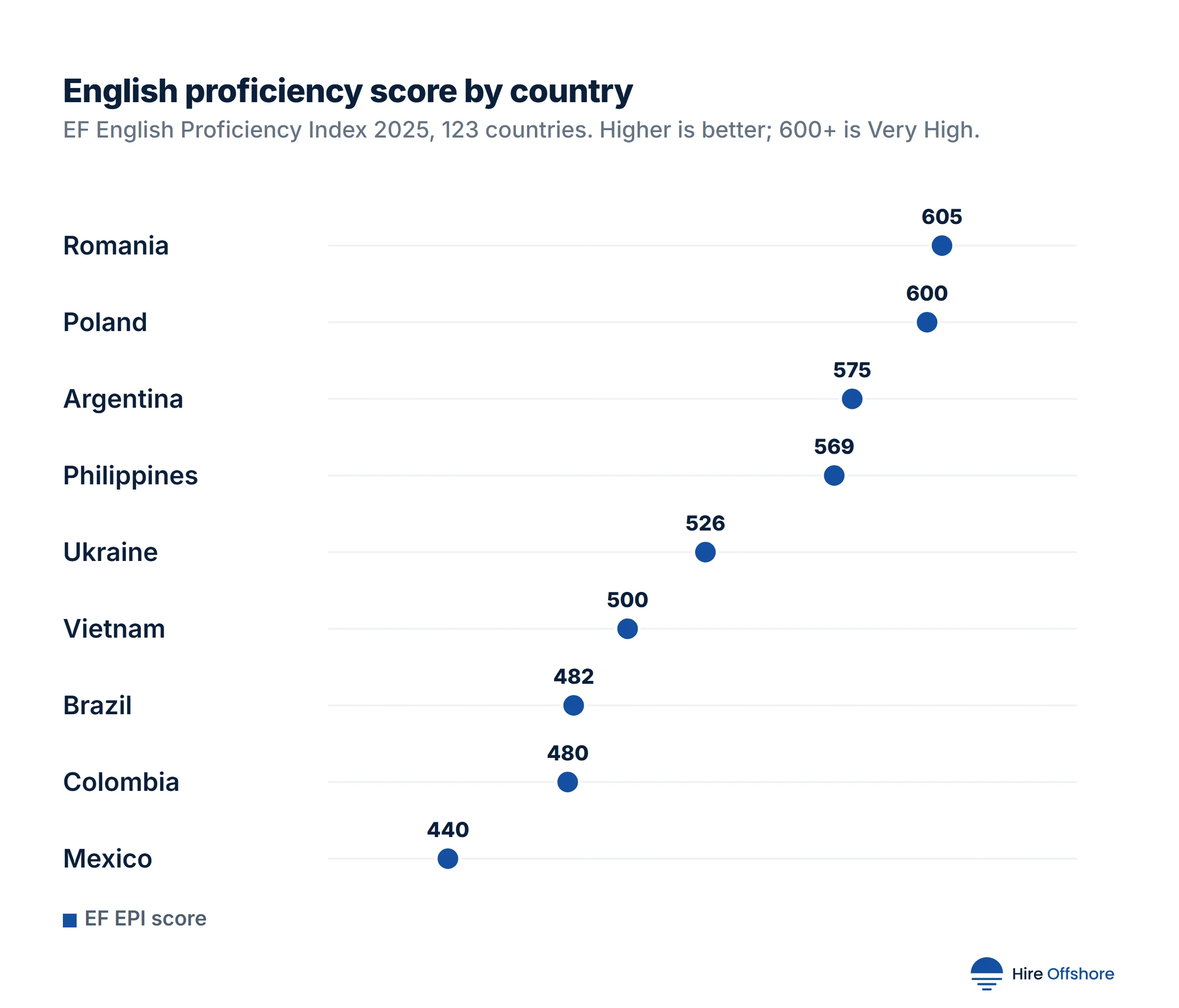
Eastern Europe leads, with Romania at 605 and Poland at 600. Mexico, the closest market to most US buyers, scores 440, 103rd of 123. Vietnam scores 500, in the Moderate band, after a 22-point rise on the previous edition. Country averages hide individuals, which is why we test every offshore developer’s English at C1 or above before a client sees a profile.
What a five-person team costs for a year
Put the rates together for a team of five senior developers working a full year of 2,076 hours each.
| Route | Basis | Five developers, one year |
|---|---|---|
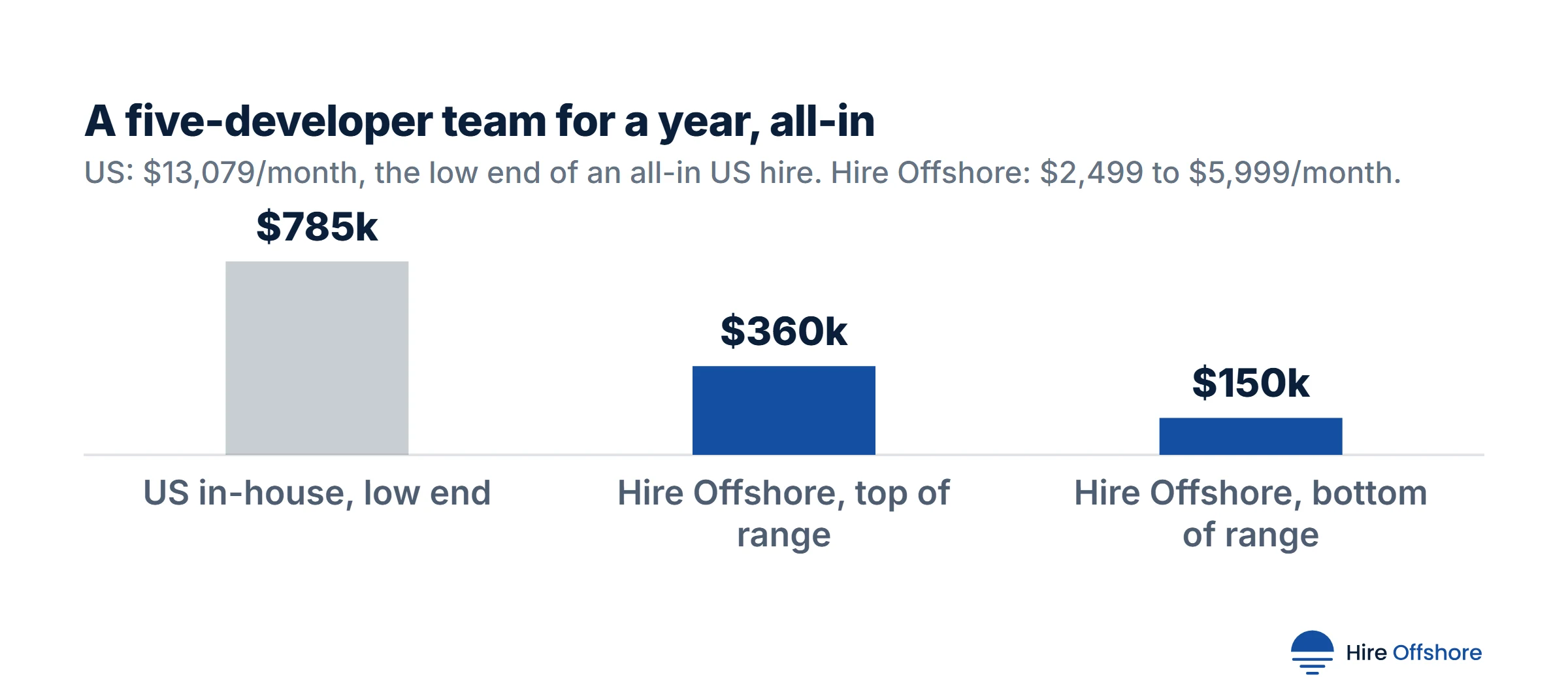
| US in-house | $13,079 a month all-in, low end | $784,740 |
| Nearshore vendor, Eastern Europe | $70 an hour, Accelerance midpoint | $726,600 |
| Nearshore vendor, Latin America | $67.50 an hour, Accelerance midpoint | $700,650 |
| Offshore vendor, South Asia | $36 an hour, Accelerance midpoint | $373,680 |
| Hire Offshore, Vietnam or the Philippines | $2,499 to $5,999 a month all-in | $149,940 to $359,940 |
At vendor rates, a senior nearshore team costs within 10% of the cheapest US option. The offshore routes cost about half or less, and a Hire Offshore team includes employment and equipment in that figure.
Nearshore team of five
- $700,650 to $726,600 a year at vendor rates
- 4 to 7 shared hours with US or UK offices
Hire Offshore team of five
- $149,940 to $359,940 a year, all-in
- 4 to 6 hours of US overlap on a shifted schedule
When nearshore wins, and when offshore does
Outsourcing is not shrinking. In Deloitte’s 2024 Global Outsourcing Survey, 80% of executives planned to keep or increase outsourcing spend. The choice is where.
Large companies already split the difference. Deloitte’s 2025 global business services survey names India, the US and Poland as the top three locations for shared-service centers, with Mexico rising into the top three preferred locations. Most big buyers run both routes at once: nearshore for work that needs the shared day, offshore for work that scales.
Nearshore fits when
- The work runs on live collaboration: daily pairing, frequent calls, a product owner who decides in meetings.
- The developer faces US or UK customers during their business day.
- Budget matters less than a shared clock.
Offshore fits when
- The team already works in writing: tickets, pull requests, recorded demos.
- You are in Australia or New Zealand, where Vietnam and the Philippines share most of the working day.
- You are hiring several developers and the cost gap compounds across the team.
Hire offshore developers with Hire Offshore
We shortlist 6 to 8 vetted offshore developers from Vietnam or the Philippines within 24 hours and complete the hire in 2 weeks. The monthly fee of $2,499 to $5,999 covers salary, payroll, equipment and employment, with no upfront cost. See pricing or send us the role.
FAQ
Is nearshore cheaper than offshore?
No. Median engineer pay in Latin America and Eastern Europe runs 2 to 5 times the median in Vietnam or the Philippines, and senior nearshore vendor rates run about twice South Asian vendor rates. Nearshore costs more in exchange for shared office hours.
How much overlap does an offshore developer give a US team?
None on a standard 9 to 5 day, because Manila is 12 hours ahead of New York in summer. Offshore developers who work a shifted schedule give 4 to 6 hours of overlap.
Which is better for a UK company?
Eastern Europe gives the most overlap, 6 to 7 hours with Warsaw or Kyiv. Vietnam and the Philippines cost less and share 1 to 2 hours, so they suit teams that already work in writing.