
 Vietnam
 The Philippines
 India

A software engineer in Australia earns a median of A$152,148 a year on Levels.fyi, about $106,300. The same title in the Philippines pays ₱967,890, about $15,400. Sydney is two or three hours ahead of Manila, so the two cities share most of a working day.
That makes the Philippines vs Australia offshore developer costs question different from the European and North American versions. The clock is a small factor. What is left to compare is pay, the employer costs on each payroll, English, the rules for ending a contract, and what five engineers cost for a year on each route.
- Median software engineer pay is about $106,300 a year in Australia and $15,400 in the Philippines, on Levels.fyi data read on 19 October 2026. That is almost seven to one.
- Super adds 12% to an Australian engineer's pay, and NSW payroll tax another 6.1% once a business is over the threshold. Philippine statutory costs add 15.4%.
- Sydney and Manila share 5 to 6 of 8 office hours on a standard day. A Manila day that starts at 6am or 7am covers all 8, with no night premium.
- Five engineers at the median cost about $595,200 to $627,700 a year in Sydney and $88,600 employed directly in the Philippines.
What a software engineer earns in each country
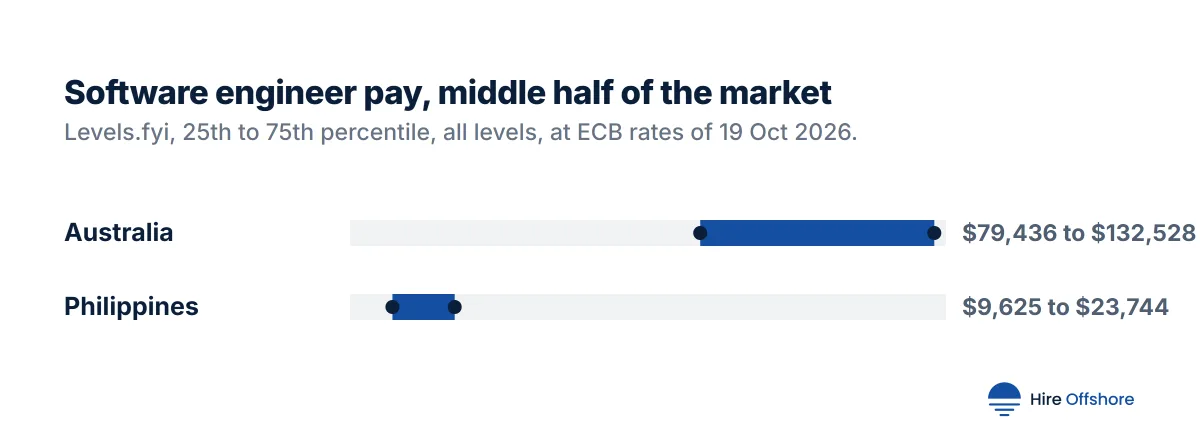
Levels.fyi reports pay for the same “Software Engineer” title in both countries. Read on 19 October 2026, the Australia page gives a median total pay of A$152,148 a year from 1,612 submissions. The Philippines page gives ₱967,890 from 97 submissions.
At the European Central Bank reference rates for 19 October 2026, taken through the Frankfurter API, one dollar bought AUD 1.4314 or PHP 62.998. That puts the Australian median at $106,293 and the Philippine median at $15,364.
| Measure | Australia | Philippines |
|---|---|---|
| 25th percentile | A$113,704 ($79,436) | ₱606,362 ($9,625) |
| Median | A$152,148 ($106,293) | ₱967,890 ($15,364) |
| 75th percentile | A$189,701 ($132,528) | ₱1,495,824 ($23,744) |
| Submissions | 1,612 | 97 |
The two ranges sit far apart. The Philippine 75th percentile, $23,744, is less than a third of the Australian 25th percentile. A Filipino engineer at the 75th percentile costs less in salary than an Australian one at the 25th.
For the same comparison against Canada, where the ratio is closer to six to one, see our Philippines vs Canada breakdown.
Employer costs in Australia
Australia has no social security levy on employers. PwC’s corporate summary says so in as many words. The cost sits in two other places.
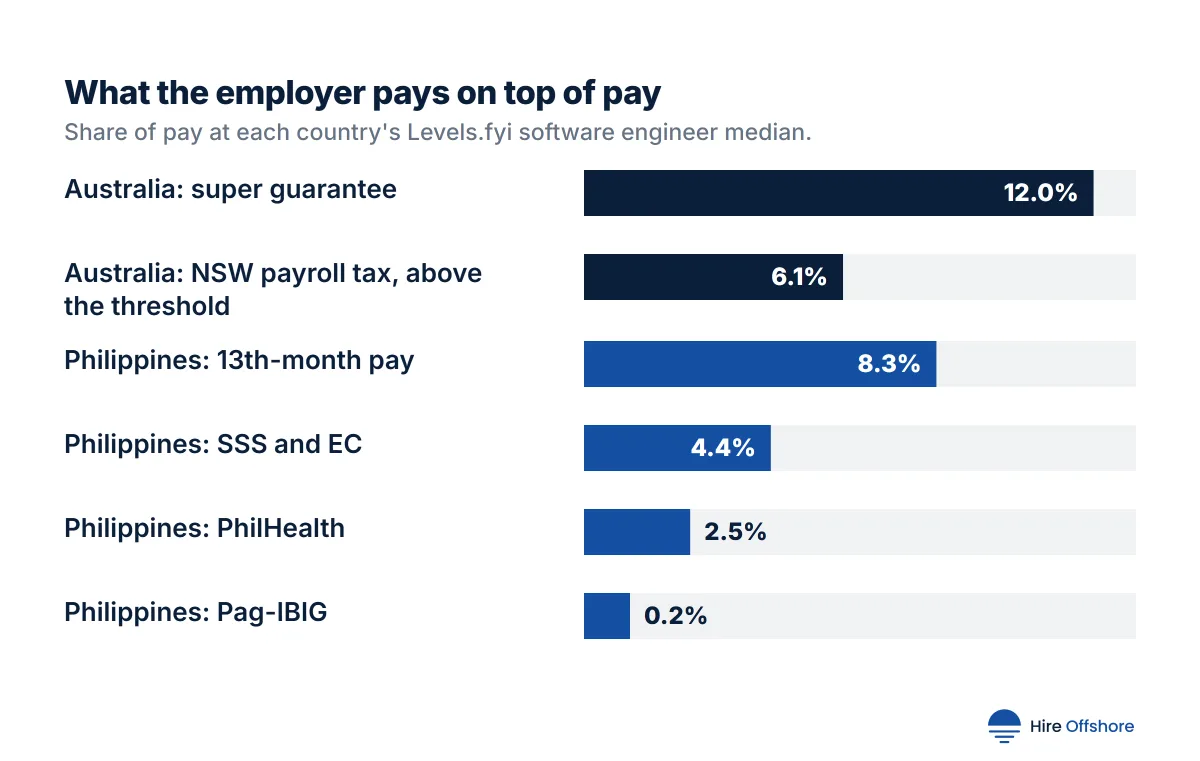
Superannuation guarantee. Employers pay a minimum share of each employee’s earnings into a super fund. The rate rose to 12% from 1 July 2025 and stays there, per PwC’s individual summary. The obligation stops at a maximum contribution base. In 2025-26 that base was A$62,500 a quarter. From 1 July 2026 it is an annual figure of A$270,830, which caps the employer’s contribution at A$32,499.60, according to SuperGuide. The Levels.fyi median sits well under the base, so the full 12% applies.
Payday Super also starts in 2026-27. From 1 July 2026, PwC notes, employers pay contributions within seven business days of each payday, subject to exceptions, rather than once a quarter. The rate does not change, but the cash leaves sooner.
State payroll tax. Each state and territory taxes payroll above its own threshold. In New South Wales the rate is 5.45% on wages above A$1.2 million a year, unchanged for 2025-26 and 2026-27, per Revenue NSW. Revenue NSW also counts super contributions as taxable wages. On a median engineer, that makes the marginal cost 5.45% of pay plus super, or 6.1% of pay.
The threshold matters for a small team. Five engineers at the median, with super, come to about A$852,000 a year, under the A$1.2 million line. A business whose only Australian staff are those five pays no NSW payroll tax. A business already over the line pays it on each new hire.
Annual leave. The National Employment Standards in the Fair Work Act 2009 give full-time employees 4 weeks of paid annual leave a year (section 87). The leave is paid out of salary, so it adds no cash cost in this model. A leave loading on top is a different matter. The Act lets modern awards set leave loadings (section 139), and an employer owes one only where an award, enterprise agreement or contract provides it. The model leaves it out.
Workers’ compensation. Each state runs its own scheme, and the premium depends on the scheme, the industry and the employer. It is not modeled here.
Employer costs in the Philippines
The Philippine items are smaller in money, and the largest are capped at low salary levels.
SSS. The Social Security System charges 15% of the monthly salary credit, with the employer paying 10% and the employee 5%, on a credit capped at ₱35,000, according to SSS. The employer also pays ₱30 a month for employees’ compensation cover. On a median engineer’s ₱80,658 a month, the employer’s share stops at ₱3,530, or 4.4% of pay.
PhilHealth. The premium is 5% of monthly basic salary, between a ₱10,000 floor and a ₱100,000 ceiling, per PhilHealth Advisory 2025-0002. A 2026 advisory keeps the 5% rate. Employer and employee split it equally, as Sprout’s worked example shows, so the employer pays 2.5%.
Pag-IBIG. Employers remit 2% of a monthly fund salary that tops out at ₱10,000 since February 2024, per Forvis Mazars’ summary of Circular 460. That is ₱200 a month at most.
13th-month pay. Presidential Decree 851 requires one-twelfth of the year’s basic salary, paid by 24 December. It adds 8.3% to annual pay.
Night shift differential. Article 86 of the Labor Code adds at least 10% of the regular wage for each hour worked between 10pm and 6am. European and US hours trigger it. An Australian buyer does not, because a Manila schedule that covers Sydney hours starts at 6am or 7am, after the window closes.
Computed from the sources above at each country's Levels.fyi median, 19 October 2026.
In percentage terms the two payrolls land close together. In money they do not. At the median, Australian super alone is about A$18,260 a year, or $12,760. The whole Philippine on-cost is about ₱149,000, or $2,370.
Time zones: Sydney and Manila share a day
Manila runs on UTC+8 all year and has not observed daylight saving since 1991, as the Philippine Standard Time entry records. Sydney and Melbourne run on AEST, UTC+10, in the southern winter and AEDT, UTC+11, in summer. Brisbane stays on UTC+10 and Perth on UTC+8 all year, per the Time in Australia entry.
The NSW Government puts the current switch on Sunday 4 October 2026, ending on Sunday 4 April 2027. Queensland, Western Australia and the Northern Territory do not change their clocks.
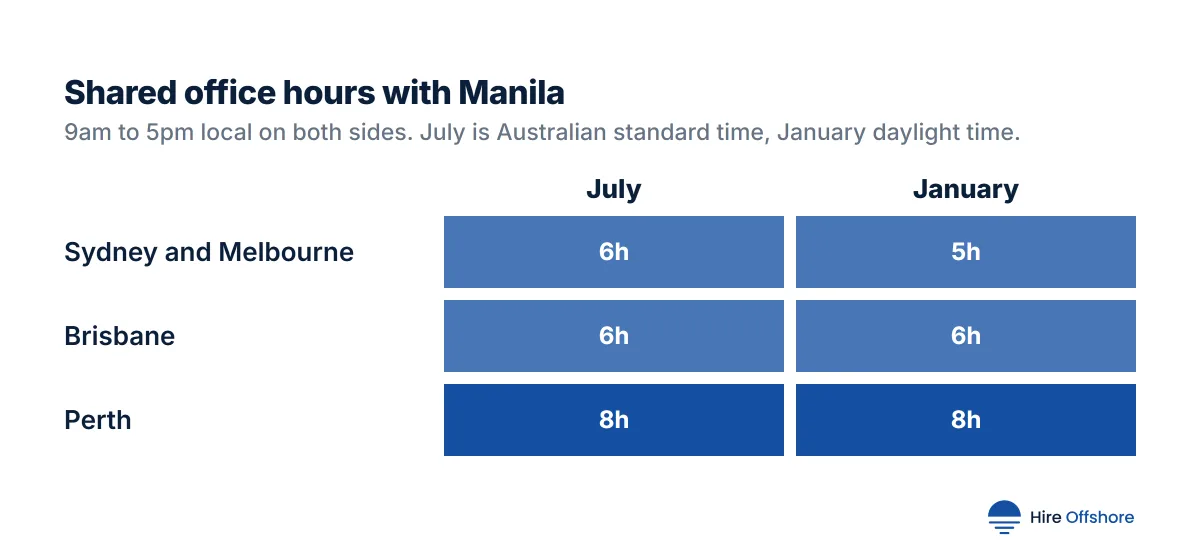
The arithmetic is short. In July, a Sydney day of 9am to 5pm runs from 7am to 3pm in Manila, so a standard Manila day shares 6 hours of it. In January, Sydney’s day runs from 6am to 2pm Manila time, and the overlap drops to 5 hours. Brisbane shares 6 hours all year. Perth shares the same clock as Manila, so the overlap is the full 8.
To cover the whole Sydney day, a Filipino engineer starts at 7am in winter and 6am in summer. Both start times sit outside the 10pm to 6am night window, so no differential applies. Our UK comparison shows the opposite case: a standard Manila day shares one hour or none with London.
Sydney
- 8 hours with a local team
- Daylight saving moves Manila overlap between 5 and 6 hours
Manila
- 5 to 6 hours on a standard day, 8 on a 6am or 7am start
- No night shift differential on either schedule
English: the case for the Philippines
The EF English Proficiency Index 2025 ranks the Philippines 28th of 123 countries and regions, with a score of 569 against a global average of 488. City scores run higher where most engineers work: Manila 603, Cebu City 585 and Davao City 579.
Australia does not appear in EF’s ranking, and neither do the UK, the US or Canada. English is the working language there, so there is no country score to set against the Philippine one. The useful comparison for an Australian buyer is between a Filipino candidate and the standard of their own team.
These are averages across adults who take the test, not engineers. A Filipino candidate still needs testing. We test every offshore developer at C1 or above before a client sees a profile, whatever the country average.
Notice, probation and ending a contract
The two labor codes price an exit in different ways. None of this is legal advice.
Australia. The Fair Work Act sets no probation period as such. Its equivalent is the minimum employment period for unfair dismissal claims under section 383: 6 months, or one year for a small business employer. Section 23 defines a small business employer as one with fewer than 15 employees. Section 382 adds a second test: the employee must be covered by a modern award or enterprise agreement, or earn less than the high income threshold. A well-paid engineer outside an award may sit above it.
Notice under section 117 runs on length of service:
- Up to 1 year: 1 week
- More than 1 year and up to 3: 2 weeks
- More than 3 years and up to 5: 3 weeks
- More than 5 years: 4 weeks
An employee over 45 with at least 2 years’ service gets one more week. The employer can pay in lieu of notice at the full rate of pay.
Redundancy pay under section 119 starts at 4 weeks after one year’s service and peaks at 16 weeks between nine and ten years. Section 121 removes it for employees with less than 12 months’ service and for small business employers.
A small business employer has one more tool. Section 385 treats a dismissal as unfair only if, among other tests, it was not consistent with the Small Business Fair Dismissal Code. Section 388 says a dismissal is consistent with the Code when the employer was a small business and followed it.
The Philippines. The Labor Code caps probation at six months. An employee who resigns without just cause gives at least one month’s written notice. An employer that cuts a role for redundancy serves written notice on the employee and the labor department at least one month ahead and pays at least one month’s pay per year of service.
| Rule | Australia | Philippines |
|---|---|---|
| Probation | No statutory period; unfair dismissal protection after 6 months, or 1 year in a small business | Up to 6 months |
| Statutory notice | 1 to 4 weeks by service, plus 1 week over 45 | One month for redundancy |
| Redundancy pay | 4 to 16 weeks; none in a small business | One month’s pay per year of service |
| Paid leave | 4 weeks a year | 5 days’ service incentive leave after a year |
The Philippine leave figure comes from Article 95 of the Labor Code. On redundancy the Philippine rule is the more generous per year of service: a month’s pay a year, against an Australian scale that tops out at 16 weeks. On a Filipino salary, the sum is still small.
What five engineers cost for a year
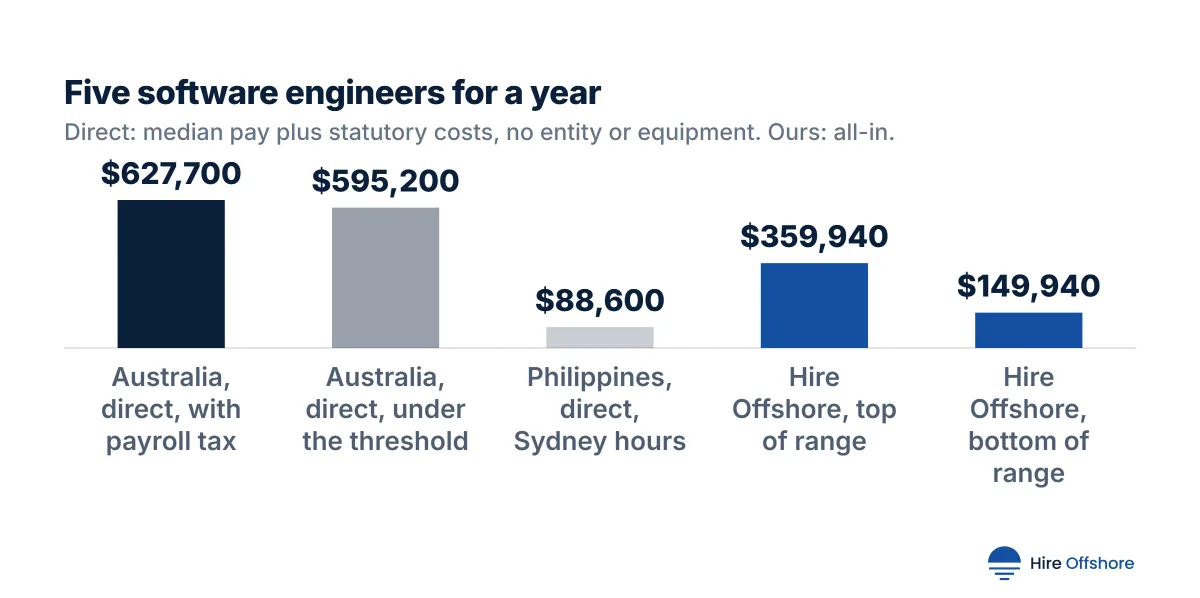
Put the pieces together for a team of five at each country’s median pay. These are direct-employment figures: salary plus the statutory costs above, converted at the 19 October rates.
| Route | Per engineer, per year | Five engineers, one year |
|---|---|---|
| Australia, Sydney, with NSW payroll tax | A$179,687 ($125,532) | A$898,400 ($627,700) |
| Australia, Sydney, under the threshold | A$170,406 ($119,048) | A$852,000 ($595,200) |
| Philippines, direct hire, Sydney hours | ₱1,116,945 ($17,730) | $88,600 |
| Hire Offshore, all-in | $29,988 to $71,988 | $149,940 to $359,940 |
In Australian dollars, our range works out to about A$3,577 to A$8,587 a month per offshore developer, or A$214,600 to A$515,200 for five over a year.
The direct figures leave out three things:
- The cost of employing anyone at all: a local company or an employer of record, payroll, recruiting fees, laptops and the time spent replacing a hire who leaves.
- Workers’ compensation premiums and any leave loading an award or contract sets.
- The spread around the median, which the pay chart shows is wide in both countries.
At the bottom of our range, five Filipino offshore developers cost about a quarter of five Sydney engineers under the payroll tax threshold. At the top, about 60%. The Philippine direct figure is lower again, because it carries none of the employment and replacement costs.
For how these rates sit against other markets, our offshore developer rates in US dollars lays them out by country.
When Australia wins, and when the Philippines does
Australia fits when
- The engineer needs to be on site with customers, regulators or hardware.
- The role handles data that a contract or regulator says must stay with staff in Australia.
- You need a security clearance or a citizenship requirement met.
- The team is small and meets in person, and a local hire fills a gap the rest of the team cannot.
The Philippines fits when
- The team works on Sydney, Melbourne, Brisbane or Perth hours and wants most of the day shared without a night shift.
- You are hiring several engineers and want the per-head saving to compound.
- You want six months of probation to judge a hire, and an exit cost you can predict.
- The work runs on tickets, pull requests and daily calls, which a 5 to 8 hour overlap supports.
Running a split team takes some process: shared stand-up times, written specs and a review rhythm. Our guide to managing offshore developers covers how.
Hire offshore developers with Hire Offshore
We hire in the Philippines, Vietnam and India, not in Australia. We shortlist 6 to 8 vetted offshore developers within 24 hours and complete the hire in 2 weeks. The monthly fee of $2,499 to $5,999 covers salary, payroll, equipment and employment, with no upfront cost and a 90-day replacement guarantee.
We agree the schedule before the offer, so a Filipino offshore developer can start early enough to cover your Australian working day. Filipino offshore developers cover stacks such as PHP and Java. See how it works, check pricing or send us the role.
FAQ
Is it cheaper to hire developers in the Philippines than in Australia?
Yes, by a wide margin. Median software engineer pay on Levels.fyi is about $15,400 a year in the Philippines against $106,300 in Australia. Five engineers at the median cost about $88,600 a year employed directly in the Philippines and $595,200 to $627,700 in Sydney.
What is the time difference between Sydney and Manila?
Manila is 2 hours behind Sydney from early April to early October, and 3 hours behind during Australian daylight saving. Manila does not change its clocks. Perth and Manila share the same time all year.
How many hours do Filipino offshore developers overlap with an Australian team?
On a standard 9am to 5pm day, 5 to 6 hours with Sydney or Melbourne, 6 with Brisbane and 8 with Perth. A Manila start at 6am or 7am covers the full Sydney day.
Do Filipino developers get a night shift premium for Australian hours?
No. The Philippine Labor Code adds at least 10% to pay for hours worked between 10pm and 6am. A schedule that matches Sydney starts at 6am or 7am Manila time, outside that window.
How much does super add to an Australian developer’s cost?
The super guarantee is 12% of earnings from 1 July 2025. From 1 July 2026 it applies up to a maximum contribution base of A$270,830 a year. At the Levels.fyi median of A$152,148, that is about A$18,260 a year.
Does NSW payroll tax apply to a small development team?
Only above the threshold. NSW charges 5.45% on wages above A$1.2 million a year, and counts super as wages. Five engineers at the median come to about A$852,000 with super, so a business with no other Australian staff stays under the line.
How much notice do you give an Australian employee?
One to four weeks under section 117 of the Fair Work Act, depending on service, plus one week for employees over 45 with at least two years’ service. The employer can pay in lieu of notice.