
 Vietnam
 The Philippines
 India
India
A software engineer in Mexico earns about three times what one in the Philippines earns, on the same Levels.fyi title. Mexico City shares a full working day with Chicago. Manila shares none of it.
That is the Mexico nearshore vs Philippines offshore decision in two lines. For a US buyer, six numbers settle it: pay, the employer costs on top, the clock, English, the cost of ending a contract, and what five engineers cost for a year in each country.
- Median software engineer pay is about $47,500 a year in Mexico and $15,400 in the Philippines, on Levels.fyi data read on 12 October 2026.
- Statutory costs add about 30% to a Mexican engineer's base pay, and 15% to a Filipino engineer's, or 25% on a full US night shift.
- Mexico City overlaps 6 to 8 hours with every major US time zone. Manila overlaps none on a standard day.
- The Philippines ranks 28th of 123 on EF's English index. Mexico ranks 103rd.
What a software engineer earns in each country
Levels.fyi reports pay for the same “Software Engineer” title in both countries, which makes it the cleanest like-for-like source. Read on 12 October 2026, the Mexico page gives a median total pay of MX$864,960 a year from 505 submissions. The Philippines page gives ₱969,264 from 96 submissions.
Converted at the European Central Bank reference rates for 9 October 2026, the latest published, through the Frankfurter API, that is about $47,525 in Mexico and $15,429 in the Philippines. One dollar bought MXN 18.20 or PHP 62.82.
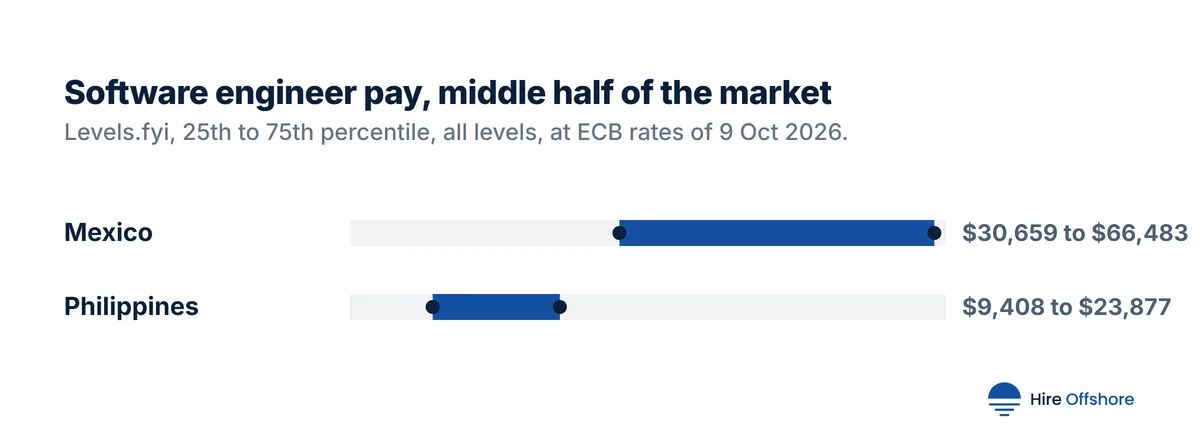
| Measure | Mexico | Philippines |
|---|---|---|
| 25th percentile | MX$558K ($30,659) | ₱591K ($9,408) |
| Median | MX$864,960 ($47,525) | ₱969,264 ($15,429) |
| 75th percentile | MX$1.21M ($66,483) | ₱1.5M ($23,877) |
| Submissions | 505 | 96 |
The ranges do not overlap. The Philippine 75th percentile sits below the Mexican 25th percentile, so even a well-paid Filipino engineer costs less in salary than a junior-band Mexican one on this data.
Our nearshore vs offshore cost comparison sets these two countries against eight others. Here the focus stays on the two that US buyers most often weigh against each other.
Employer costs in Mexico
Salary is the start of a Mexican payroll. Five items sit on top.
Social security, housing and retirement. PwC’s individual tax summary for Mexico puts the employer’s maximum social security contribution at MXN 227,286 a year for a low-risk company, reached once salary passes MXN 1,070,155. That ceiling works out to 21.2% of pay. PwC’s corporate summary lists two of the parts: 2% of base salary for retirement and 5% for the housing fund, known as INFONAVIT, with other rates that vary by salary.
State payroll tax. Most states levy one, paid by the employer. PwC gives Mexico City’s rate as 4%.
Aguinaldo. Article 87 of the Federal Labor Law sets a year-end bonus of at least 15 days’ salary, paid before 20 December, as the text of the article reads. Fifteen days is 4.1% of a year’s pay.
Vacation and its premium. After one year an employee gets at least 12 working days of paid leave, rising by two days a year, under Article 76. Article 80 adds a vacation premium of at least 25% of the pay for those days, about 0.8% of annual pay.
Profit sharing, or PTU. PwC’s corporate summary sets it at 10% of adjusted taxable income. It is not paid in a company’s first year of operations, and since 2021 each employee’s share is capped at the higher of three months’ salary or the average of the last three years. For a median engineer, three months is about MX$216,000, or $11,900.
Mexico is also shortening its working week. A constitutional reform published in the Diario Oficial on 3 March 2026 cuts the maximum from 48 hours to 40 by 2030, two hours a year from 2027, and bars any cut in pay or benefits, according to Holland & Knight. The same salary will buy fewer hours each year until then.
Employer costs in the Philippines
The Philippine items are smaller, and the largest are capped at low salary levels.
SSS. The Social Security System charges 15% of the monthly salary credit, with the employer paying 10% and the employee 5%, on a credit capped at ₱35,000, according to SSS. The employer also pays ₱30 a month for employees’ compensation cover. On a median engineer’s ₱80,772 a month, the employer’s share stops at ₱3,530, or 4.4% of pay.
PhilHealth. The premium is 5% of monthly basic salary, between a ₱10,000 floor and a ₱100,000 ceiling, per PhilHealth Advisory 2025-0002. A 2026 advisory keeps the 5% rate. Employer and employee split it equally, as Sprout’s worked example shows, so the employer pays 2.5%.
Pag-IBIG. Employers remit 2% of a monthly fund salary that tops out at ₱10,000 since February 2024, per Forvis Mazars’ summary of Circular 460. That is ₱200 a month at most.
13th-month pay. Presidential Decree 851 requires one-twelfth of the year’s basic salary, paid by 24 December. It adds 8.3% to annual pay.
Night shift differential. This is the item a US buyer triggers. Article 86 of the Labor Code adds at least 10% of the regular wage for each hour worked between 10pm and 6am. A Manila engineer on New York hours works 9pm to 5am in July and 10pm to 6am in January, so almost every hour qualifies.
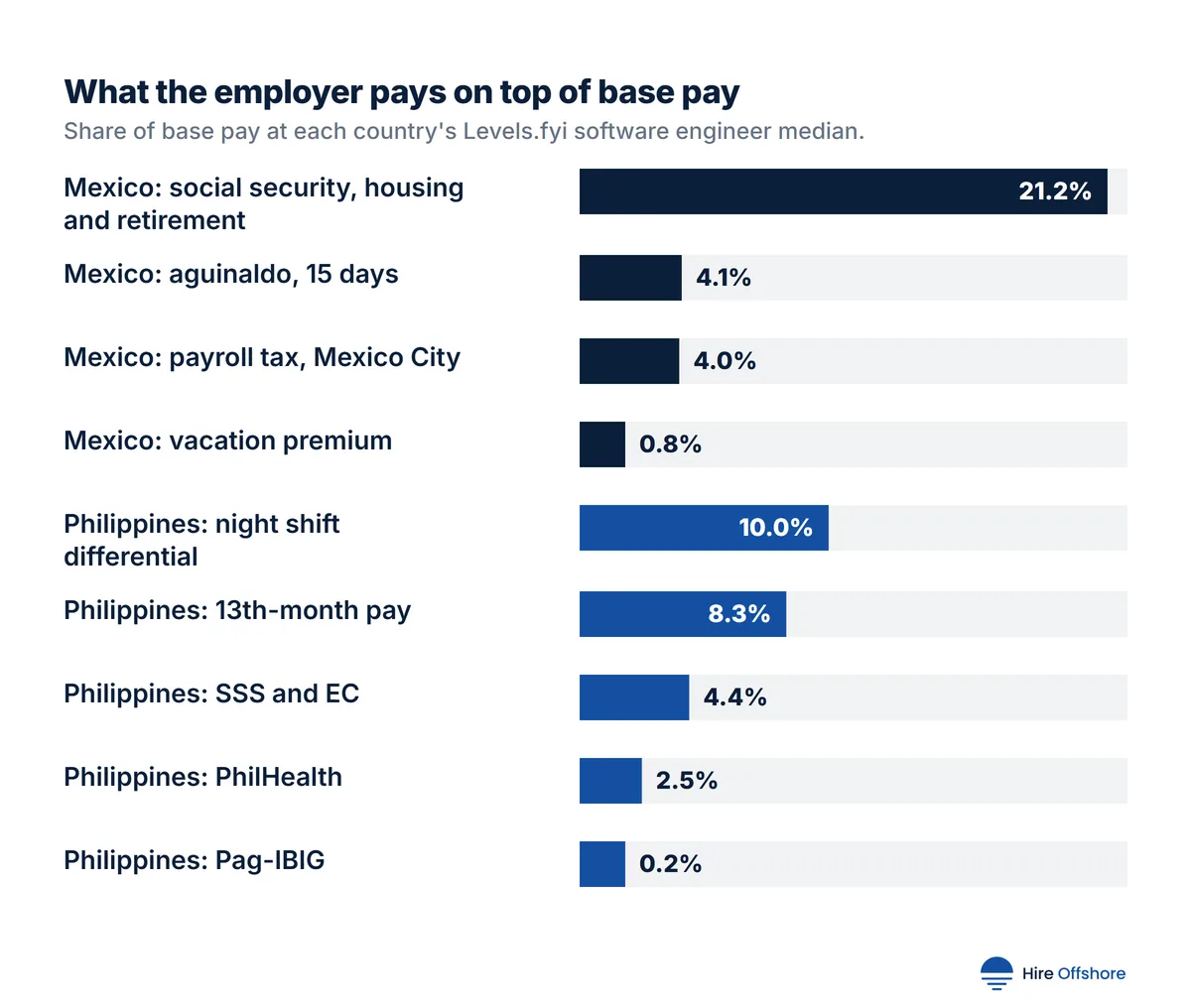
Computed from the sources above at each country's Levels.fyi median, 12 October 2026.
The percentages move with salary. Mexico’s social security ratio holds up to a ceiling of MXN 1,070,155 a year, between the Levels.fyi median and the 75th percentile, so it covers most engineers in full. The Philippine SSS and Pag-IBIG caps bite early, so their share shrinks as pay rises, while the 13th month and night differential stay proportional.
Time zones: the case for Mexico
Mexico ended daylight saving time across the country under the Ley de los Husos Horarios, published in October 2022, as the Energy Ministry notes. The northern border strip, including Ciudad Juárez, Nuevo Laredo, Reynosa and all of Baja California, still changes its clocks with the US. Mexico City stays on UTC-6 all year.
The Philippines runs on UTC+8 and has not observed daylight saving since 1991, as the Philippine Standard Time entry records. The US moves its clocks on 8 March and 1 November 2026, per NIST.
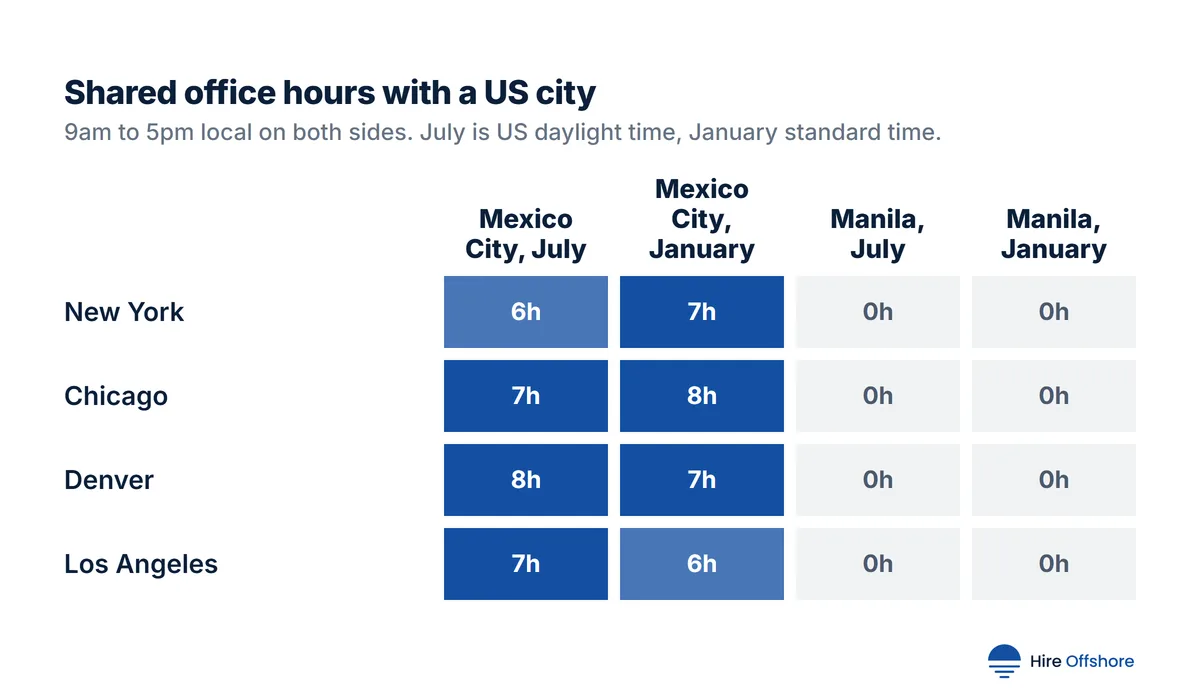
Because Mexico no longer moves its clocks, the overlap shifts by an hour twice a year. New York gains an hour with Mexico City in winter, and Los Angeles loses one. Denver and Mexico City share a clock from March to November.
Manila is 12 hours ahead of New York in July and 13 in January, and 15 to 16 hours ahead of Los Angeles. A standard Manila day ends before New York wakes up. To overlap at all, a Filipino engineer works a shifted day, and to overlap fully, a night shift with the 10% differential above.
Mexico City
- 6 to 8 hours of shared office time with any US time zone
- No schedule shift and no night premium
Manila
- 0 hours on a standard day
- Overlap needs a shifted schedule, and a full US day needs a night shift
English: the case for the Philippines
The EF English Proficiency Index 2025 ranks the Philippines 28th of 123 countries with a score of 569. Mexico ranks 103rd with 440, down 19 points on the previous edition and below the global average of 488.
City scores widen the gap in the cities where most engineers work. Manila scores 603, Cebu City 585 and Davao City 579. Monterrey leads the Mexican cities at 532, Guadalajara scores 511, and Mexico City scores 428.
| City | EF EPI 2025 score |
|---|---|
| Manila | 603 |
| Cebu City | 585 |
| Davao City | 579 |
| Monterrey | 532 |
| Guadalajara | 511 |
| Mexico City | 428 |
These are averages across adults who take the test, not engineers. Plenty of Mexican engineers work in fluent English, and a Filipino candidate still needs testing. The averages do tell a buyer how deep each English-speaking pool runs. We test every offshore developer at C1 or above before a client sees a profile, whatever the country average.
Probation, notice and ending a contract
The two labour codes price an exit in different ways, and the difference shows up in the cost of a hire that does not work out. None of this is legal advice.
Mexico. Probation on an indefinite contract can last up to 30 days, or up to 180 days for managerial roles and specialised technical or professional work, under Article 39-A. After that, a dismissal the employer cannot justify lets the employee claim three months’ salary plus back wages of up to 12 months under Article 48. On an indefinite contract, when indemnity replaces reinstatement, Article 50 adds 20 days’ salary for each year worked.
On top, Article 162 sets a seniority premium of 12 days’ salary per year of service. It is paid on any dismissal, justified or not, and on resignation once the employee has 15 years of service.
The Philippines. The Labor Code caps probation at six months. An employee who resigns without just cause gives at least one month’s written notice. An employer that cuts a role for redundancy serves written notice on the employee and the labour department at least one month ahead and pays at least one month’s pay per year of service.
| Rule | Mexico | Philippines |
|---|---|---|
| Probation | Up to 30 days, or 180 for specialised roles | Up to 6 months |
| Cost of a dismissal without cause | 3 months’ pay, back wages up to 12 months, 20 days a year where indemnity replaces reinstatement | Redundancy: one month’s pay per year, one month’s notice |
| Seniority premium | 12 days a year on any dismissal | None |
| Paid leave | 12 days after year one, plus 25% premium | 5 days’ service incentive leave after a year |
The Philippine leave figure comes from Article 95 of the Code. In practice, the longer Philippine probation gives an employer six months to judge a hire, against one month for most Mexican roles.
What five engineers cost for a year
Put the pieces together for a team of five at each country’s median pay. These are direct-employment figures: salary plus the statutory costs above, converted at the 9 October rates.
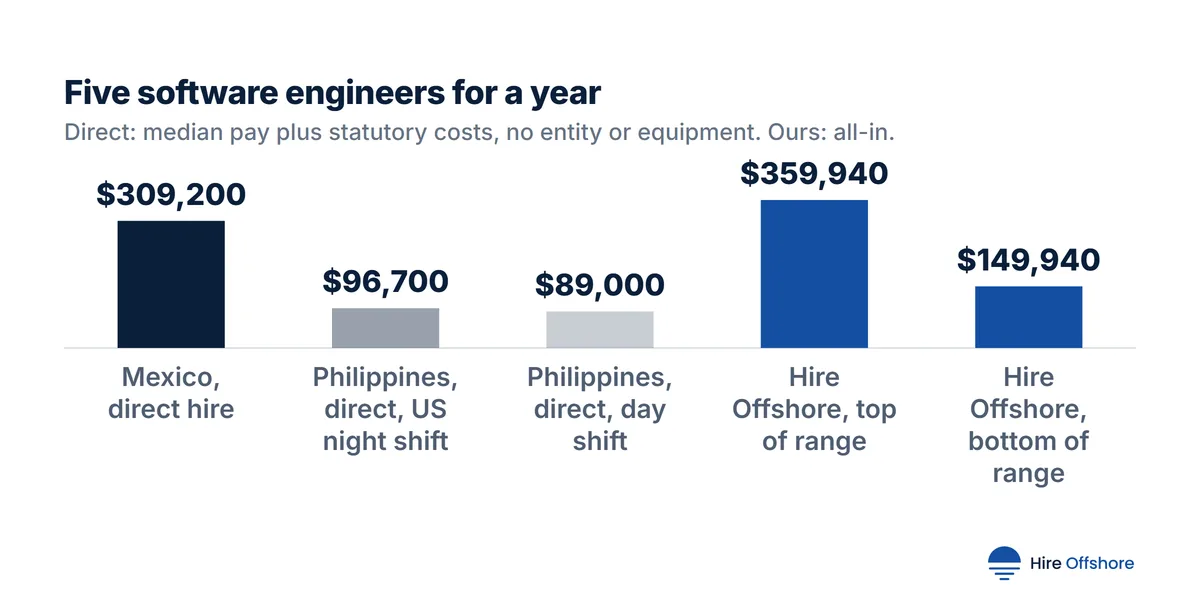
| Route | Per engineer, per year | Five engineers, one year |
|---|---|---|
| Mexico, direct hire, Mexico City | $61,830 | $309,200 |
| Philippines, direct hire, US night shift | $19,348 | $96,700 |
| Philippines, direct hire, day shift | $17,805 | $89,000 |
| Hire Offshore, all-in | $29,988 to $71,988 | $149,940 to $359,940 |
The direct figures leave out three things:
- Mexican profit sharing, which can add up to about $11,900 per engineer in a profitable year.
- The cost of employing anyone at all: a local company or an employer of record, payroll, recruiting fees, laptops and the time spent replacing a hire who leaves.
- The spread around the median, which the pay chart shows is wide in both countries.
Even so, the gap is structural. A Mexican team costs about three times a Philippine one on the same title, and the night shift premium adds only about ,700 a year to the Philippine team.
When Mexico wins, and when the Philippines does
Mexico fits when
- The work runs on live collaboration: pairing, frequent calls, a product owner who decides in meetings.
- The engineer will join customer calls or support US users during their business day.
- You already have, or plan to set up, a Mexican entity and can carry profit sharing.
- Budget per engineer matters less than a shared clock.
The Philippines fits when
- The team already works in writing: tickets, pull requests, recorded demos and async review.
- English fluency across the whole team matters more than overlap.
- You are hiring several engineers and want the per-head saving to compound.
- You want six months of probation to judge a hire, and an exit cost you can predict.
Some buyers split the work: a small Mexican team for the meetings-heavy roles, and Filipino offshore developers for the build. Our customers page has case studies from teams that took the offshore route.
Hire offshore developers with Hire Offshore
We do not hire in Mexico. We hire in the Philippines, Vietnam and India, and we shortlist 6 to 8 vetted offshore developers within 24 hours and complete the hire in 2 weeks. The monthly fee of $2,499 to $5,999 covers salary, payroll, equipment and employment, with no upfront cost and a 90-day replacement guarantee.
We agree the schedule before the offer, and our offshore developers overlap 4 to 6 hours with a US workday. Filipino offshore developers cover stacks such as PHP and Java. See how it works, check pricing or send us the role.
FAQ
Is Mexico or the Philippines cheaper for software engineers?
The Philippines, by a wide margin. Median software engineer pay on Levels.fyi is about $15,400 a year there against $47,500 in Mexico, and Mexican employer costs add about 30% to base pay against 15% to 25% in the Philippines.
How many hours does a Mexican developer overlap with a US team?
Six to eight hours on a standard 9 to 5 day, depending on the US city and the season. Mexico City stays on UTC-6 all year, so the overlap with New York is 6 hours in summer and 7 in winter.
Do offshore developers in the Philippines work US hours?
They can, on a shifted or night schedule. Manila is 12 to 16 hours ahead of the US, so a full US day falls between about 9pm and 9am Manila time, and the Labor Code adds at least 10% to pay for hours worked between 10pm and 6am.
Which country has better English, Mexico or the Philippines?
The Philippines. EF’s English Proficiency Index 2025 ranks it 28th of 123 countries with a score of 569, while Mexico ranks 103rd with 440. Manila scores 603 and Mexico City 428.
Is it harder to let an employee go in Mexico?
In most cases, yes. A Mexican employee dismissed without proven cause can claim three months’ salary, back wages of up to 12 months and a seniority premium. In the Philippines a redundancy costs at least one month’s pay per year of service, after one month’s notice.